Highlights
Listen
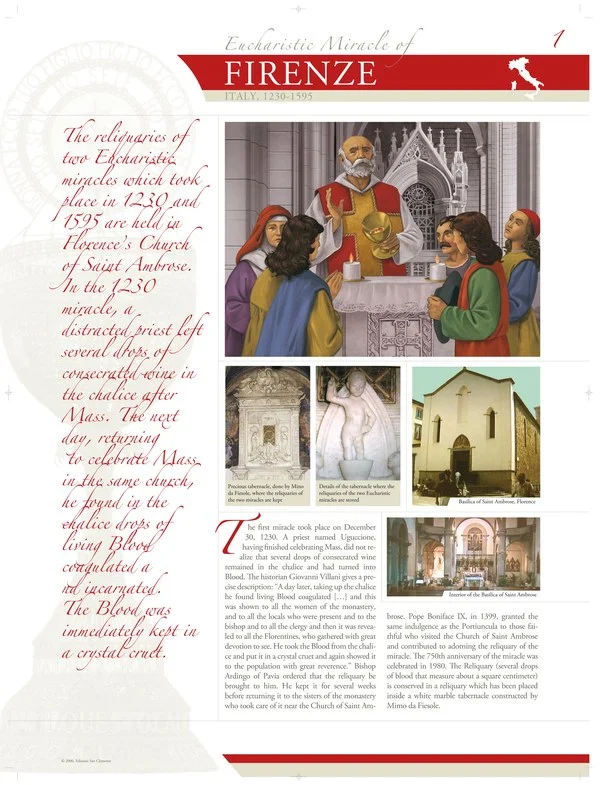
Etoe ITALY, 1230-1595 ( Y are ezces C e 230 tract serer / retar e (41mss t same L cr st having finished celebrating Mass, did not re- alize that several drops of consecrated wine remained in the chalice and had turned into Blood. historian Giovanni Villani gives a pre- cise description: "A day later, taking up the chalice he found living Blood coagulated ] and this was shown to all the women of the monastery, and to all the locals who were present and to the bishop and to all the clergy and then it was revea- led to all the Florentines, who gathered with great devotion to see. He took the Blood from the chali- ce and put it in a crystal cruet and again showed it to the population with great reverence." Bishop Ardingo of Pavia ordered that the reliquary be brought to him.
He kept it for several weeks before returning it to the sisters of the monastery who took care of it near the Church of Saint Am- thful who visited the Church of Saint Ambrose and contributed to adorning the reliquary of the miracle. The 750th anniversary of the miracle was celebrated in 1980. The Reliquary (several drops of blood that measure about a square centimeter) is conserved in a reliquary which has been placed inside a white marble tabernacle constructed by Mimo da Fiesole.
Etoe istöo morae meus t Ost (U Sepulchre, fell to the ground and started a fire. The population immediately rushed to put out the fire and succeeded in saving the Blessed Sacra- ment and chalice. In the great commotion, six fragments of consecrated Hosts fell from the pyx onto the smoldering carpet, but despite the fire were found intact and joined together.
In 1628, Archbishop Marzio Medici of Florence examined them and found them incorrupt. He had them placed in a precious reliquary. Every May during the Forty Hours devotion, the two reliquaries are exposed together in a reliquary that also contains a consecrated Host for public adoration.
Chiesa di S. Ambrogio in cammino verso il Congresso Eucaristico il Giubileo del 2000 29 Maggio 1997 "CORPUS DOMINE the first miracle that took place Uguccione carrying the Blood in procession
🔬 Scientific & Forensic Investigation
Rigorous histological, immunological and chromatographic analysis verified authentic human tissue with no chemical preservatives.
Relic Gallery & Historical Records
Fotografias em alta definição das sagradas relíquias, basílicas e documentos históricos catalogados por São Carlo Acutis. Clique para ampliar.

Basilica of Saint Ambrose, Florence

Precious tabernacle, done by Mino da Fiesole, where the reliquaries of the two miracles are kept he first miracle took place on December 30, 1230. A priest named Uguccione,

Interior of the Basilica of Saint Ambrose brose. Pope Boniface IX, in 1399, granted the same indulgence as the Portiuncula to those fai-

Details of the tabernacle where the reliquaries of the two Eucharistic miracles are stored

Gilded reliquary and sacred relic preserved from the Eucharistic Miracle of Florence (1230, 1595)

ITALY, 1230-1595 a lit can le on the alta fa side chapel called the

Reliquary of the drops of wine transformed into living Blood

that survived the fire

Reliquary of the Hosts

Fresco in the basilica depicting in 1230, showing the priest

Miracolo Eucaristico 1230 -

Historical artwork and preserved documentation of the Eucharistic Miracle of Florence (1230, 1595)
Original Exhibition Panels by Saint Carlo Acutis (300 DPI)
Inspecione a composição gráfica original em alta resolução (300 DPI, formato 60×80 cm), com o design e tipografia preservados exatamente como idealizados pelo autor.