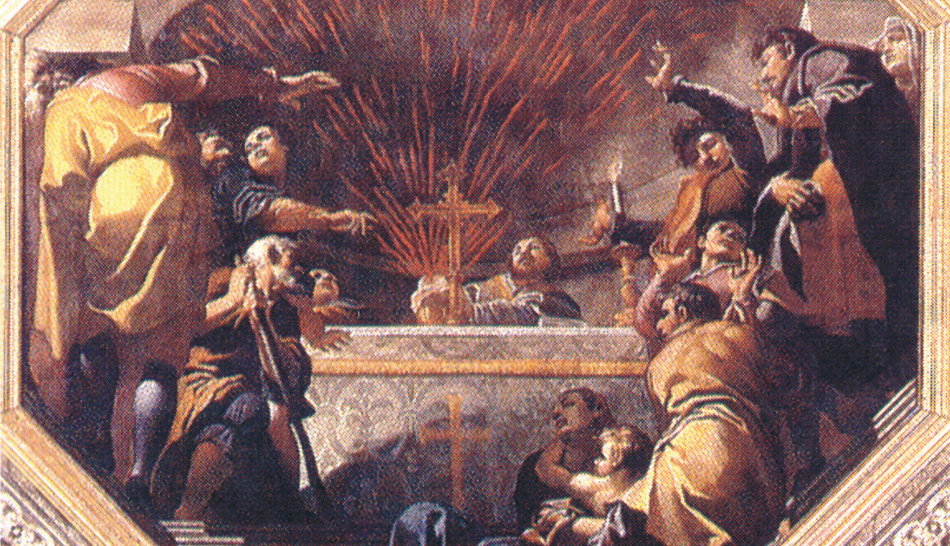
MIRACOLI—panneaux 12/05/06 14 : 33 Page 6 This Eucharistic miracle took place in Ferrara, in the Basilica of Saint Mary in V ado, on Easter Sunday, March 28, 1171 , While celebrating Easter Mass, Father Pietro da Verona, the prior of the basilica, reached the moment of breaking the consecrated Host, At this point he saw that Blood gushed from the Host, staining the ceiling of the crypt above the altar with droplets, In 1595 the crypt was enclosed within a small shrine and is still visible today in the monumental Basilica of Santa Maria in Vado. da Verona, was celebrating Easter Mass with three confreres (Bono, Leonardo and Aimone). At the moment of the breaking of the consecrated Host, Blood gushed forth from the Host and threw large drops on the ceiling of the small crypt above the altar.
Histories tell of the "holy fear of the celebrant and of the immense wonder of the people who crowded the tiny church." There were many eyewitnesses who told of seeing the Host take on a Bloody color and having seen in the Host the figure of a Baby. Bishop Amato of Ferrara and Archbishop Ghe- rardo of Ravenna were immediately informed of the event. They witnessed with their own eyes the miracle, namely "the Blood which we saw redden the ceiling of the crypt." The church immediately became a pilgrim destination, and later was rebu- ITALY, 1171 The ceiling crypt stained with Blood ilt and expanded on the orders of Duke Ercole d'Este beginning in 1495.
Sdtt/ACCS regarding this miracle. Amon e most important is the Bull of Pope Eugene IV (March 30, 1442), in which the pontiff mentions the miracle in refe- rence to the testimonies of the faithful and an- cient historical sources. The 1197 manuscript of Gerardo Cambrense, conserved in Canter- bury's Lambeth Library is the oldest document that mentions the miracle.
Elhe miracle recei- ved recent attention in the "Gemma Ecclesia- stica" (Budding of the Church) by historian Antonio Samaritani. Another document which dates to March 6, 1404, is the Bull of Cardinal Migliorati, in which he grants indulgences to those who visit the church and adore the Mi- raculous Blood." Even today, on the 28th day TIRE-SIT• •ape:. *.e.uei sionaries of the Most Precious Blood, Eucharistic Adoration is celebrated in memory of the mira- clee And every year, in preparation for the Feast of Corpus Christi, the solemn Forty Hours devo- tion is celebrated.
The eighth centenary of the miracle was celebrated in 1971.
🔬 Scientific & Forensic Investigation
Rigorous histological, immunological and chromatographic analysis verified authentic human tissue with no chemical preservatives.
Relic Gallery & Historical Records
High-definition photographs of sacred relics, basilicas, and historical documents cataloged by Saint Carlo Acutis. Click to enlarge.

n March 28, 1171, the prior of the Canons Regular Portuensi, Father Pietro

Bodini, The Miracle of the Blood. Painting on the ceiling near the shrine

Bull of Eugene IV (1442)

The Basilica of Santa Maria in Vado in Ferrara, site of the Eucharistic Miracle of Easter 1171

John Paul II pauses before the ceiling vault in Ferrara Church of Saint Mary in V ado, Ferrara

Detail of the vault ceiling stained with Blood

Father Pietro da Verona breaking the Host, which sprayed living Blood onto the vault above the altar

Panoramic view of the Sanctuary and high altar honoring the Eucharistic Miracle of Ferrara (1171)

Historical artwork and preserved documentation of the Eucharistic Miracle of Ferrara (1171)

E Shrine that encloses the Holy Vault Ceiling (1594). Right side of the cross of every month in the basilica, which is currently under the care of Saint Gaspare del Bufalo's Mis-

Gilded reliquary and sacred relic preserved from the Eucharistic Miracle of Ferrara (1171)
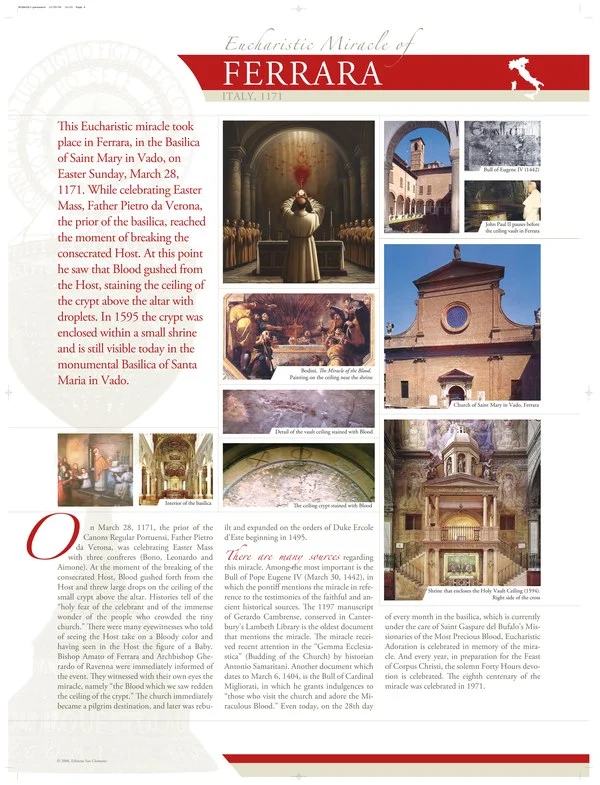
Original Exhibition Panels by Saint Carlo Acutis (300 DPI)
Inspect the original high-resolution graphic composition (300 DPI, 60×80 cm format), with design and typography preserved exactly as conceived by the author.