Highlights
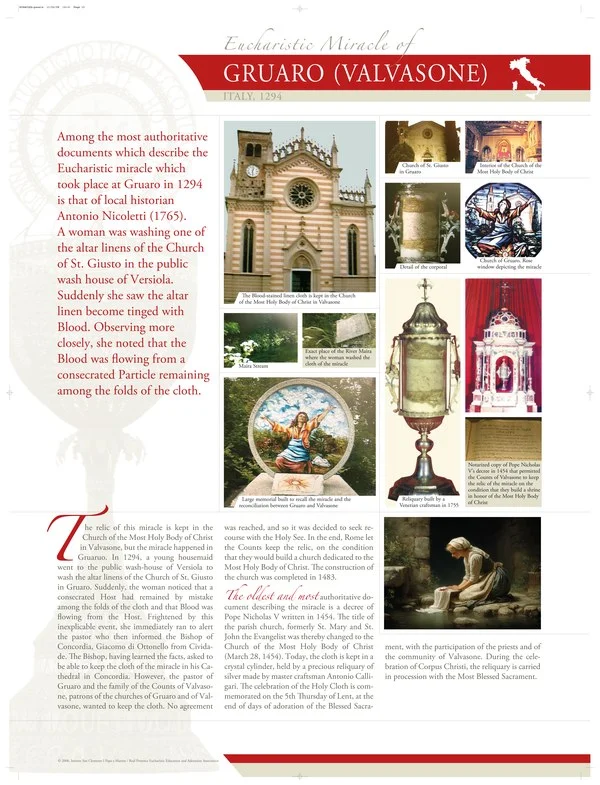
MIRACLES-panels 11/02/08 14:31 Page 15 Among the most authoritative documents which describe the Eucharistic miracle which took place at Gruaro in 1294 is that of local historian Antonio Nicoletti (1765). A woman was washing one of the altar linens of the Church of St. Giusto in the public wash house of Versiola, Suddenly she saw the altar linen become tinged with Blood, Observing more closely, she noted that the Blood was flowing from a consecrated Particle remaining among the folds of the cloth.
he relic of this miracle is kept in the Church of the Most Holy Body of Christ in Valvasone, but the miracle happened in Gruaruo. In 1294, a young housemaid went to the public wash-house of Versiola to wash the altar linens of the Church of St. Giusto in Gruaro.
Suddenly, the woman noticed that a consecrated Host had remained by mistake among the folds of the cloth and that Blood was flowing from the Host. Frightened by this inexplicable event, she immediately ran to alert the pastor who then informed the Bishop of Concordia, Giacomo di Ottonello from Civida- dee The Bishop, having learned the facts, asked to be able to keep the cloth of the miracle in his Ca- thedral in Concordia. However, the pastor of Gruaro and the family of the Counts of Valvaso- ne, patrons of the churches of Gruaro and of Val- vasone, wanted to keep the cloth.
No agreement GRUARO (VALVASONE) ITALY, 1294 Giusto the Counts keep the relic, on the condition that they would build a church dedicated to the Most Holy Body of Christ. The construction of the church was completed in 1483. mad authoritative do- cument describing the miracle is a decree of Pope Nicholas V written in 1454.
The title of the parish church, formerly St. Mary and St. John the Evangelist was thereby changed to the Church of the Most Holy Body of Christ (March 28, 1454). Today, the cloth is kept in a crystal cylinder, held by a precious reliquary of silver made by master craftsman Antonio Calli- gari.
The celebration of the Holy Cloth is com- memorated on the 5th Elhursday of Lent, at the end of days of adoration of the Blessed Sacra- in honor of the Most Holy Body of Christ Venetian craftsman in 1755 ment, with the participation of the priests and of bration of Corpus Christi, the reliquary is carried in procession with the Most Blessed Sacrament.
🔬 Scientific & Forensic Investigation
Rigorous histological, immunological and chromatographic analysis verified authentic human tissue with no chemical preservatives.
Relic Gallery & Historical Records
Fotografias em alta definição das sagradas relíquias, basílicas e documentos históricos catalogados por São Carlo Acutis. Clique para ampliar.

Church of St. in Gruaro

Notarized copy of Pope Nicholas V's decree in 1454 that permitted the Counts of Valvasone to keep the relic of the miracle on the condition that they build a shrine

The Blood-stained linen cloth is kept in the Church of the Most Holy Body of Christ in Valvasone Maira Stream

cloth of the miracle Large memorial built to recall the miracle and the reconciliation between Gruaro and Valvasone was reached, and so it was decided to seek re- course with the Holy See. In the end, Rome let

Historical documentation and sacred art honoring the Eucharistic life of the saints

Detail of the corporal

Interior of the Church of the Most Holy Body of Christ

Church of Gruaro. Rose window depicting the miracle

Historical artwork and preserved documentation of the Eucharistic Miracle of Gruaro-Valvasone (1294)

Exact place of the River Maira where the woman washed the

Reliquary built by a the community of Valvasone. During the cele-
Original Exhibition Panels by Saint Carlo Acutis (300 DPI)
Inspecione a composição gráfica original em alta resolução (300 DPI, formato 60×80 cm), com o design e tipografia preservados exatamente como idealizados pelo autor.