Highlights
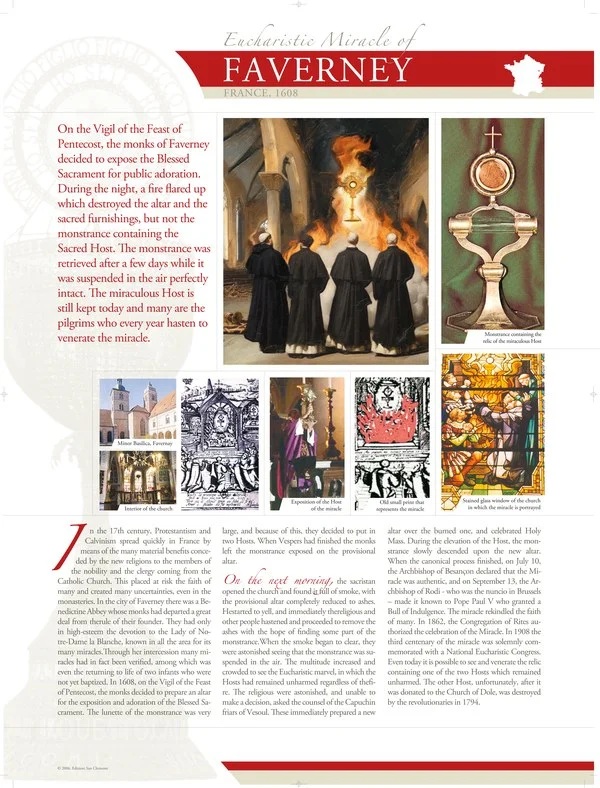
FRANCE, 1608 On the Vigil of the Feast of Pentecost, the monks of Faverney decided to expose the Blessed Sacrament for public adoration, During the night, a fire flared up which destroyed the altar and the sacred furnishings, but not the monstrance containing the Sacred Host, monstrance was retrieved after a few days while it was suspended in the air perfectly intact. The miraculous Host is still kept today and many are the pilgrims who every year hasten to venerate the miracle, means of the many material benefits conce- ded by the new religions to the members of the nobility and the clergy coming from the many and created many uncertainties, even in the monasteries. In the city of Faverney there was a Be- nedictine Abbey whose monks had departed a great deal from therule of their founder.
They had only in high-esteem the devotion to the Lady of No- tre-Dame la Blanche, known in all the area for its many miracles. Through her intercession many mi- racles had in fact been verified, among which was even the returning to life of two infants who were not yet baptized. In 1608, on the Vigil of the Feast of Pentecost, the monks decided to prepare an altar for the exposition and adoration of the Blessed Sa- crament.
lhe lunette of the monstrance was very {M_E7ii7/ l] Stained glass window of the church in which the miracle is portrayed altar. the sacristan opened the church and found 't II of smoke, with the provisional altar completely reduced to ashes. Hestarted to yell, and immediately thereligious and other people hastened and proceeded to remove the ashes with the hope of finding some part of the monstrance.
When the smoke began to clear, they were astonished seeing that the monstrance was su- spended in the air. The multitude increased and crowded to see the Eucharistic marvel, in which the Hosts had remained unharmed regardless of thefi- re. The religious were astonished, and unable to make a decision, asked the counsel of the Capuchin friars of Vesoul.
These immediately prepared a new strance slowly descended upon the new altar. When the canonical process finished, on July 10, the Archbishop of Besanqon declared that the Mi- racle was authentic, and on September 13, the Ar- chbishop of Rodi - who was the nuncio in Brussels made it known to Pope Paul V who granted a Bull of Indulgence. The miracle rekindled the faith of many.
In 1862, the Congregation of Rites au- thorized the celebration of the Miracle. In 1908 the third centenary of the miracle was solemnly com- memorated with a National Eucharistic Congress. Even today it is possible to see and venerate the relic containing one of the two Hosts which remained unharmed.
The other Host, unfortunately, after it was donated to the Church of Dole, was destroyed by the revolutionaries in 1794.
🔬 Scientific & Forensic Investigation
Rigorous histological, immunological and chromatographic analysis verified authentic human tissue with no chemical preservatives.
Relic Gallery & Historical Records
Fotografias em alta definição das sagradas relíquias, basílicas e documentos históricos catalogados por São Carlo Acutis. Clique para ampliar.

n the 17th century, Protestantism and large, and because of this, they decided to put in Calvinism spread quickly in France by two Hosts. When Vespers had finished the monks

relic of the miraculous Host altar over the burned one, and celebrated Holy

Minor Basilica, Favernay

Interior of the church

Old small print that represents the miracle Mass. During the elevation of the Host, the mon-

Exposition of the Host of the miracle left the monstrance exposed on the provisional

Monstrance containing the

Marian sanctuary and historical record of the Eucharistic prodigy associated with Our Lady
Original Exhibition Panels by Saint Carlo Acutis (300 DPI)
Inspecione a composição gráfica original em alta resolução (300 DPI, formato 60×80 cm), com o design e tipografia preservados exatamente como idealizados pelo autor.