Highlights
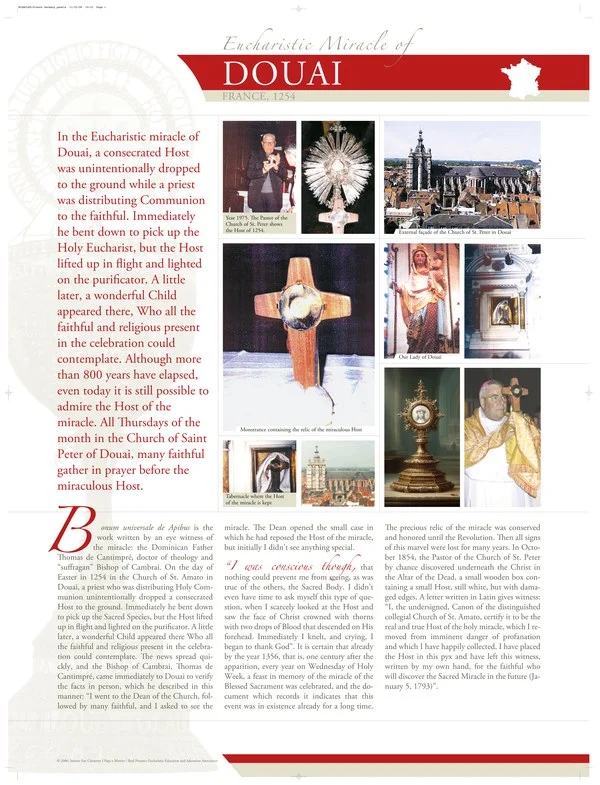
MIRACLES—France Germany panels 11/02/08 10 : 33 Page 1 In the Eucharistic miracle of Douai, a consecrated Host Ily dropped was unintentiona to the ground while a priest was distributing Communion to the faithful. Immediately he bent down to pick up the Holy Eucharist, but the Host lifted up in flight and lighted on the purificator, A little later, a wonderful Child appeared there, Who all the faithful and religious present in the celebration could contemplate, Although more than 800 years have elapsed, even today it is still possible to admire the Host of the miracle, All Thursdays of the month in the Church of Saint Peter of Douai, many faithful gather in prayer before the miraculous Host. onum universale de Apibus is the work written by an eye witness of the miracle: the Dominican Father Thomas de Cantimpré, doctor of theology and "suffragan" Bishop of Cambrai.
On the day of Easter in 1254 in the Church of St. Amato in Douai, a priest who was distributing Holy Com- munion unintentionally dropped a consecrated Host to the ground. Immediately he bent down to pick up the Sacred Species, but the Host lifted up in flight and lighted on the purificator.
A little later, a wonderful Child appeared there Who all the faithful and religious present in the celebra- tion could contemplate. The news spread qui- ckly, and the Bishop of Cambrai, Thomas de Cantimpré, came immediately to Douai to verify the facts in person, which he described in this manner: "I went to the Dean of the Church, fol- lowed by many faithful, and I asked to see the FRANCE, 1254 .•tV'.i. , • arms couscioas t that nothing could prevent me from e 'ng, as was true of the others, the Sacred Body.
I didn't even have time to ask myself this type of que- stion, when I scarcely looked at the Host and saw the face of Christ crowned with thorns with two drops of Blood that descended on His forehead. Immediately I knelt, and crying, I began to thank God". It is certain that already by the year 1356, that is, one century after the apparition, every year on Wednesday of Holy Week, a feast in memory of the miracle of the Blessed Sacrament was celebrated, and the do- cument which records it indicates that this event was in existence already for a long time.
ilk-y by chance discovered underneath the Christ in the Altar of the Dead, a small wooden box con- taining a small Host, still white, but with dama- ged edges. A letter written in Latin gives witness: "I, the undersigned, Canon of the distinguished collegial Church of St. Amato, certify it to be the real and true Host of the holy miracle, which I re- moved from imminent danger of prof anation and which I have happily collected.
I have placed the Host in this pyx and have left this witness, written by my own hand, for the faithful who will discover the Sacred Miracle in the future (Ja- nuary 5, 1793)".
🔬 Scientific & Forensic Investigation
Rigorous histological, immunological and chromatographic analysis verified authentic human tissue with no chemical preservatives.
Relic Gallery & Historical Records
Fotografias em alta definição das sagradas relíquias, basílicas e documentos históricos catalogados por São Carlo Acutis. Clique para ampliar.

Monstrance containing the relic of the miraculous Host Tabernacle where the Host of the miracle is kept

the Host of 1254.

External faqade of the Church of St. Peter in Douai gtSUS AYEZ DC "Ous

Year 1975. The Pastor of the Church of St. Peter shows

miracle. The Dean opened the small case in which he had reposed the Host of the miracle,

Historical documentation and sacred art honoring the Eucharistic life of the saints

Historical artwork and preserved documentation of the Eucharistic Miracle of Douai (1254)

The precious relic of the miracle was conserved and honored until the Revolution. Then all signs

Our Lady of Douai

but initially I didn't see anything special. of this marvel were lost for many years. In Octo- ber 1854, the Pastor of the Church of St. Peter
Original Exhibition Panels by Saint Carlo Acutis (300 DPI)
Inspecione a composição gráfica original em alta resolução (300 DPI, formato 60×80 cm), com o design e tipografia preservados exatamente como idealizados pelo autor.