Highlights
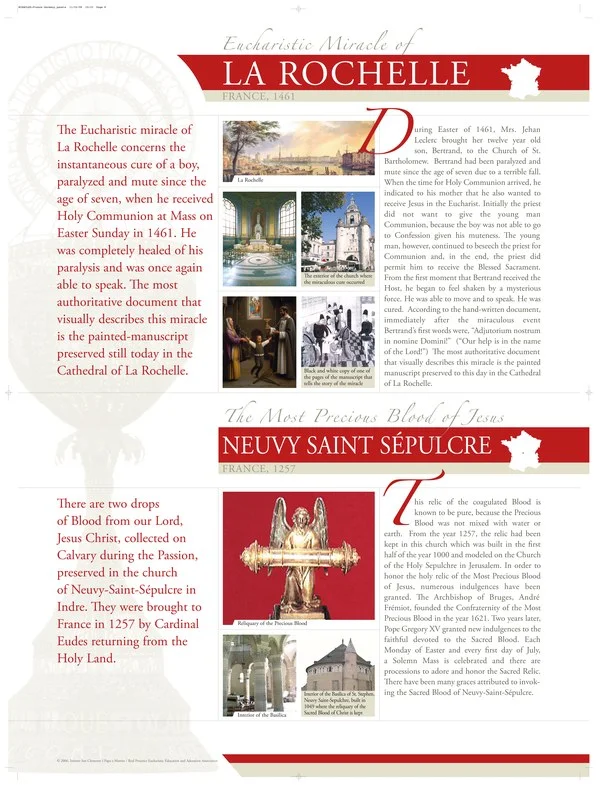
MIRACLES—France Germany panels 11/02/08 10 : 33 Page 8 The Eucharistic miracle of La Rochelle concerns the instantaneous cure of a boy, paralyzed and mute since the age of seven, when he received Holy Communion at Mass on Easter Sunday in 1461, He was completely healed of his paralysis and was once again able to speak, The most authoritative document that visually describes this miracle is the painted-manuscript preserved still today in the Cathedral of La Rochelle, There are two drops of Blood from our Lord, Jesus Christ, collected on Calvary during the Passion, preserved in the church of Neuvy-Saint-Sépulcre in Indre, They were brought to France in 1257 by Cardinal Eudes returning from the Holy Land, Black and white copy of one of tells the story of the miracle uring Easter of 1461, Mrs. Jehan Leclerc brought her twelve year old son, Bertrand, to the Church of St. Bartholomew.
Bertrand had been paralyzed and mute since the age of seven due to a terrible fall. When the time for Holy Communion arrived, he indicated to his mother that he also wanted to receive Jesus in the Eucharist. Initially the priest did not want to give the young man Communion, because the boy was not able to go to Confession given his muteness.
The young man, however, continued to beseech the priest for Communion and, in the end, the priest did permit him to receive the Blessed Sacrament. From the first moment that Bertrand received the Host, he began to feel shaken by a mysterious force. He was able to move and to speak.
He was cured. According to the hand-written document, immediately after the miraculous event Bertrand's first words were, "Adjutorium nostrum in nomine Domini!" ("Our help is in the name of the Lord!" ) The most authoritative document that visually describes this miracle is the painted manuscript preserved to this day in the Cathedral of La Rochelle. NEUW SAINT SÉPULCRE FRANCE, 1257 his relic of the coagulated Blood is known to be pure, because the Precious Blood was not mixed with water or earth.
From the year 1257, the relic had been kept in this church which was built in the first half of the year 1000 and modeled on the Church of the Holy Sepulchre in Jerusalem. In order to honor the holy relic of the Most Precious Blood of Jesus, numerous indulgences have been granted. The Archbishop of Bruges, André Frémiot, founded the Confraternity of the Most Precious Blood in the year 1621.
Two years later, Pope Gregory XV granted new indulgences to the faithful devoted to the Sacred Blood. Each Monday of Easter and every first day of July, a Solemn Mass is celebrated and there are processions to adore and honor the Sacred Relic. There have been many graces attributed to itwok- ing the Sacred Blood of Neuvy-Saint-Sépulcre.
Interior of the Basilica
Relic Gallery & Historical Records
Fotografias em alta definição das sagradas relíquias, basílicas e documentos históricos catalogados por São Carlo Acutis. Clique para ampliar.

the miraculous cure occurred the pages of the manuscript that

The exterior of the church where

La Rochelle

The Romanesque Rotunda Basilica of Saint-Étienne in Neuvy-Saint-Sépulcre, built on the model of the Holy Sepulchre

Reliquary of the Precious Blood

Reliquary containing the drops of the Most Precious Blood brought from Jerusalem in 1257 by Cardinal Eudes de Châteauroux

•(ffå'ffffiitf Interior of the Basilica of St. Stephen, Neuvy Saint-Sepulchre, built in 1049 where the reliquary of the Sacred Blood of Christ is kept

Gilded reliquary and sacred relic preserved from the Eucharistic Miracle of La Rochelle / Neuvy Saint Sépulcre (1257, 1461)
Original Exhibition Panels by Saint Carlo Acutis (300 DPI)
Inspecione a composição gráfica original em alta resolução (300 DPI, formato 60×80 cm), com o design e tipografia preservados exatamente como idealizados pelo autor.