Highlights
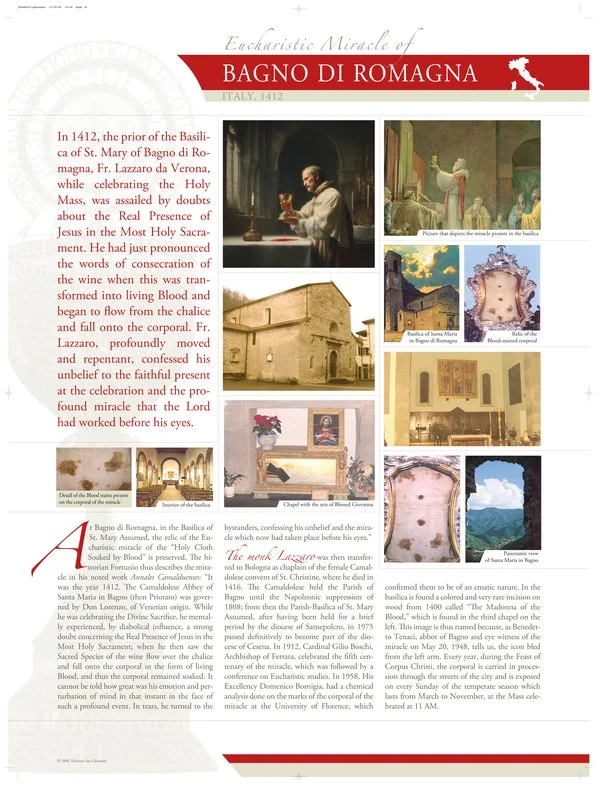
MIRACOLI—panneaux 12/05/06 14 : 34 Page 18 In 1412, the prior of the Basili- ca of St. Mary of Bagno di Ro- magna, Fr. Lazzaro da Verona, while celebrating the Holy Mass, was assailed by doubts about the Real Presence of Jesus in the Most Holy Sacra- mento He had just pronounced the words of consecration of the wine when this was tran- sformed into living Blood and began to flow from the chalice and fall onto the corporal, Fr.
Lazzaro, profoundly moved and repentant, confessed his unbelief to the faithful present at the celebration and the pro- found miracle that the Lord had worked before his eyes. BAGNO Dl ROMAGNA charistic miracle of the "Holy Cloth Soaked by Blood" is preserved. The hi- storian Fortunio thus describes the mira- cle in his noted work Annales Camalduenses: was the year 1412.
The Camaldolese Abbey of Santa Maria in Bagno (then Priorato) was gover- ned by Don Lorenzo, of Venetian origin. While he was celebrating the Divine Sacrifice, he mental- ly experienced, by diabolical influence, a strong doubt concerning the Real Presence of Jesus in the Most Holy Sacrament; when he then saw the Sacred Species of the wine flow over the chalice and fall onto the corporal in the form of living Blood, and thus the corporal remained soaked. It cannot be told how great was his emotion and per- turbation of mind in that instant in the face of such a profound event.
In tears, he turned to the then transfer- red to Bologna as chaplain of the female Camal- dolese convent of St. Christine, where he died in 1416. Elhe Camaldolese held the Parish of Bagno until the Napoleonic suppression of 1808; from then the Parish-Basilica of St.
Mary Assumed, after having been held for a brief period by the diocese of Sansepolcro, in 1975 passed definitively to become part of the dio- cese of Cesena. In 1912, Cardinal Gilio Boschi, Archbishop of Ferrara, celebrated the fifth cen- tenary of the miracle, which was followed by a conference on Eucharistic studies. In 1958, His Excellency Domenico Bornigia, had a chemical analysis done on the marks of the corporal of the miracle at the University of Florence, which wood from 1400 called "The Madonna of the Blood," which is found in the third chapel on the left.
This image is thus named because, as Benedet- to Tenaci, abbot of Bagno and eye witness of the miracle on May 20, 1948, tells us, the icon bled from the left arm. Every year, during the Feast of Corpus Christi, the corporal is carried in proces- Sion through the streets of the city and is exposed on every Sunday of the temperate season which lasts from March to November, at the Mass cele- brated at 1 1 AM.
Relic Gallery & Historical Records
Fotografias em alta definição das sagradas relíquias, basílicas e documentos históricos catalogados por São Carlo Acutis. Clique para ampliar.

Detail of the Blood stains present on the corporal of the miracle

Picture that depicts the miracle present in the basilica

Relic of the Blood-stained corporal

Basilica of Santa Maria in Bagno di Romagna

Historical documentation and sacred art honoring the Eucharistic life of the saints

Interior of the basilica t Bagno di Romagna, in the Basilica of bystanders, confessing his unbelief and the mira- St. Mary Assumed, the relic of the Eu- cle which now had taken place before his eyes.

basilica is found a colored and very rare incision on

Panoramic view of Santa Maria in Bagno confirmed them to be of an ematic nature. In the

Chapel with the urn of Blessed Giovanna

Historical artwork and preserved documentation of the Eucharistic Miracle of Bagno di Romagna (1412)

ITALY, 1412
Original Exhibition Panels by Saint Carlo Acutis (300 DPI)
Inspecione a composição gráfica original em alta resolução (300 DPI, formato 60×80 cm), com o design e tipografia preservados exatamente como idealizados pelo autor.