Highlights
MIRACOLI—panneaux 12/05/06 14 : 34 Page 32 In both the Eucharistic miracles of Asti, real blood gushed out from the consecrated Hosts, and there are numerous documents that confirm these events, In the first miracle, Mons. Scipione Roero had a notary act drawn up and, on November 6, 1535, Pope Paul III granted a plenary indulgence to anyone who visited the Church of San Secondo on the anniversary of the miraculous event, On July 25, 1535, while celebrating Mass at the main altar of the Collegiate Church of San Se- condo at about 7:00 0'clock in the morning, a holy priest by the name of Domenico Occelli prepared to break the Host and noticed that, along the entire break, the Host was becoming red with living Blood. %ree drops fell into the chalice and a fourth one remained at the extreme end of the Host.
At first, Fr. Domenico conti- nued the celebration of the Mass. But when he broke off the portion of the Host that had to be placed in the chalice, Blood came out of the Host. He could not believe his eyes, and he turned to the people, asking them to come to the altar and observe the miracle.
When the priest was about to consume the Host, the Blood disap- ITALY, 1535 peared at once and the Host returned to the na- tural purity of the Eucharist. These are the facts as described in the translation of the official report sent by Bishop Scipione Roero of Asti to the Holy See and reproduced in the Apostolic Brief of November 6, 1535. In this Apostolic Brief Pope Paul III granted a plenary indulgen- ce to those "who visited the Saint's church on the day commemorating the miracle and reci- ted three Our Fathers and Three Hail Marys according the intention of the Holy Father." document, re- produced n inscription on marble, on that occasion some heretical soldiers converted to the faith.
In those days, Asti was under the do- minion of Emperor Charles V, and many of his troops were living in the city. This account is found in the Vatican archives from which a copy was made in 1884 at the request of Canon Longo and is also found in the book of the Com- pany of the Most Blessed Sacrament, founded in the Collegiate Church of San Secondo as far back as 1519. Other testimonies are a 16th century painting in the Chapel of the Crucifixion depi- cting the miracle, as well as an inscription on marble with the words: Hic ubi Christus Ex Sacro pane Effuso sanguine Exteram vi traxit fidem Astensem roboravit - Here, having shed Blood from the Holy Bread, Christ drew foreigners to the faith and strengthened that of the people of Asti.
MIRACOLI—panneaux 12/05/06 14 : 34 Page 33 The second miracle took place in the old Chapel of Opera Pia Milliavacca and it is documen- ted by numerous testimonies gathered by a notary public, underwritten by the priest and by imminent clerical and non- denominational authorities, The morning of May 10, 1718 Father Francesco Scotto, went to the Opera Milliavacca to celebra- te the Holy Mass. It was about eight o'clock. The church of the institute was divided into two parts, the front where the extraneous could gather, and at the back behind the altar, reserved to the boarding students.
In the front part of the altar, there was only the notary public Scipione Alessandro Ambrogio, chancellor of the Bishop and treasurer of the institute, and a nephew of the priest was a server at the Mass. And in the back part there were the boarding students. When the priest was at the point of elevating the consecrated Host, Dr.
Ambrogio realized the Blessed Sacrament was divided into two Parts. As soon as the priest elevated the cup, the man, con- ITALY, 1718 t: i A' tel t Cathedral of Asti and ran in the sacristy right away to get another consecrated Host. In the meantime the priest elevated the Host and really found the two Parts tainted by Blood.
The bottom of the cup also had Blood, and little stains were on the same corporal. IL /1tCÆ/dÖteAmbrogio had arrived with a new consecrated Host and realized that that the Host was Bloody. He started to cry right away. All the people present saw the mira- clee The notary public ran to call Mr.
Argenta, confessor of the institute, the theologian V aglio and Ferrero from the penitentiary, who were also witnesses to the miracle. At the same time even the other priests and three doctors arrived. The doctors Argenta, Volpini and Vercellone, could come from the nose, or the mouth of the priest, but some surgeons present, after a meticu- Ious observation, put the doubts to peace.
Other clerical authorities intervened, and R. Bording, in agreement with everyone, wrote a report about the miracle. Another important proof of the au- thenticity of the miracle was furnished by a docu- ment which stated Monsignor Filippo Artico, Bishop of Asti, in 1841 had the cup and the con- secrated Host examined by others who confir- med the origin of the red stains.
The Opera Pia Milliavacca has kept the testimonies of the mira- clee Elhe cup with the Blood stains and the conse- crated Host, unfortunately, have not been preser- ved well.
🔬 Scientific & Forensic Investigation
Rigorous histological, immunological and chromatographic analysis verified authentic human tissue with no chemical preservatives.
Relic Gallery & Historical Records
Fotografias em alta definição das sagradas relíquias, basílicas e documentos históricos catalogados por São Carlo Acutis. Clique para ampliar.

Collegiate church of San Secondo in Asti

Interior of the collegiate church of San Secondo

G. Badarello (toward the end of the 17th century), collegiate church of San Secondo, altar of the crucifix or of the miracle

Oil Painting on canvas (of an unknown 17th century painter) depicting the Eucharistic miracle that took place in the collegiate church of San Secondo in 1535. The painting is kept in the chapel of the miracle

Gilded reliquary and sacred relic preserved from the Eucharistic Miracle of Asti (1535, 1718)

Detail of the base of the chalice of the miracle of Opera Pia Milliavacca

Opera Pia Milliavacca, Chalice of the miracle. Notice the correspondence of the drops of Blood on the cup

and the base of the chalice

Gilded reliquary and sacred relic preserved from the Eucharistic Miracle of Asti (1535, 1718)

The chalice of the miracle is kept in the Cathedral of Asti, in the chapel dedicated to St. Philip Neri

vinced that a broken consecrated Host was not attested to the fact the red stains were real Blood. valid, went toward the altar to advise the priest, Among the people there, one thought the Blood
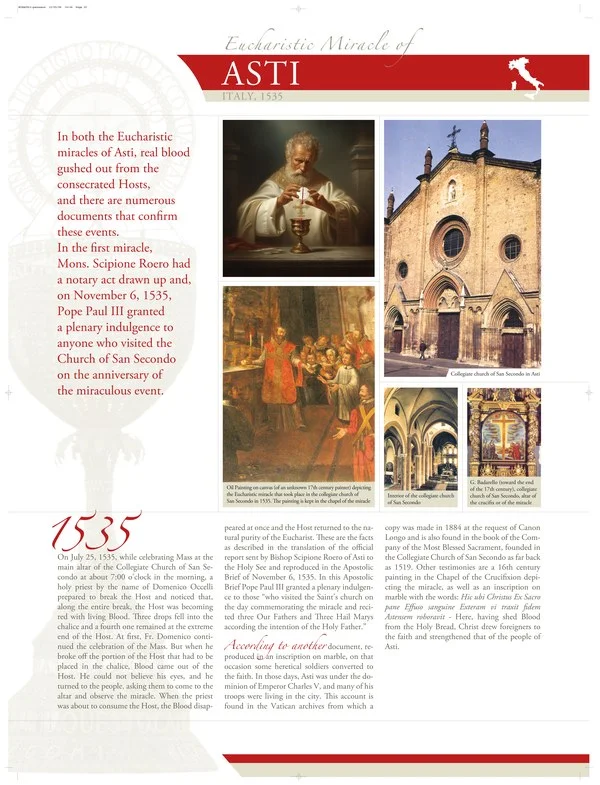
Original Exhibition Panels by Saint Carlo Acutis (300 DPI)
Inspecione a composição gráfica original em alta resolução (300 DPI, formato 60×80 cm), com o design e tipografia preservados exatamente como idealizados pelo autor.