Highlights
Listen
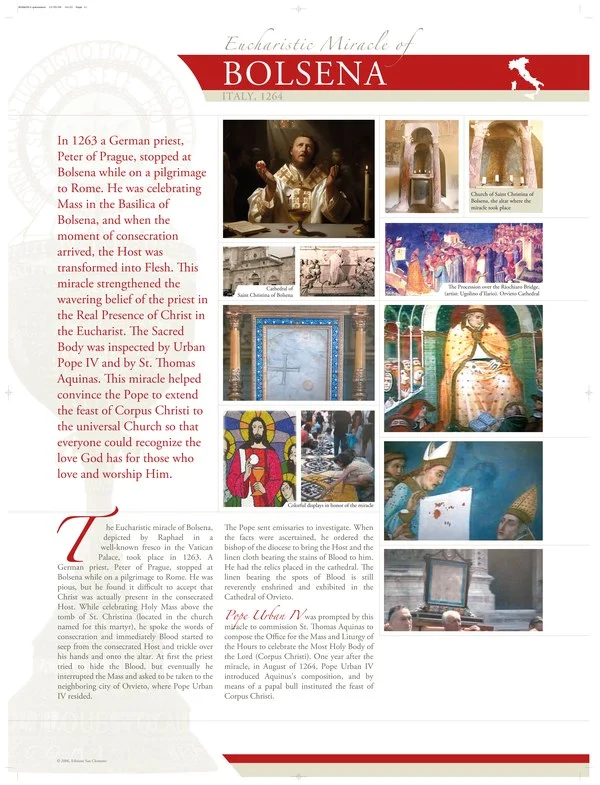
MIRACOLI—panneaux 12/05/06 14 : 33 Page 11 In 1263 a German priest, Peter of Prague, stopped at Bolsena while on a pilgrimage to Rome. He was celebrating Mass in the Basilica of Bolsena, and when the moment of consecration arrived, the Host was transformed into Flesh. This miracle strengthened the wavering belief of the priest in the Real Presence of Christ in the Eucharist, The Sacred Body was inspected by Urban Pope IV and by St.
Thomas Aquinas, This miracle helped convince the Pope to extend the feast of Corpus Christi to the universal Church so that everyone could recognize the love God has for those who love and worship Him, he Eucharistic miracle of Bolsena, depicted by Raphael in a well-known fresco in the Vatican Palace, took place in 1263. A German priest, Peter of Prague, stopped at Bolsena while on a pilgrimage to Rome. He was pious, but he found it diffcult to accept that Christ was actually present in the consecrated Host.
While celebrating Holy Mass above the tomb of St. Christina (located in the church named for this martyr), he spoke the words of consecration and immediately Blood started to seep from the consecrated Host and trickle over his hands and onto the altar. At first the priest tried to hide the Blood, but eventually he interrupted the Mass and asked to be taken to the neighboring city of Orvieto, where Pope Urban IV resided.
MDW/"' bishop of the diocese to bring the Host and the linen cloth bearing the stains of Blood to him. He had the relics placed in the cathedral. The linen bearing the spots of Blood is still reverently enshrined and exhibited in the Cathedral of Orvieto.
P n/was prompted by this nf acle to commission St. Thomas Aquinas to compose the Offce for the Mass and Liturgy of the Hours to celebrate the Most Holy Body of the Lord (Corpus Christi). One year after the miracle, in August of 1264, Pope Urban IV introduced Aquinus's composition, and by means of a papal bull instituted the feast of Corpus Christi.
MIRACLES-panels 11/02/08 14:31 Page 12 arere as CITTÄ Dl 6 GIVGno 2004 1263 or ITALY, 1264 37i7iäiii Museum of the Diocese of Milan Francesco Trevisani. The miracle of Bolsena, A VLNFrSAORL Public adoration in honor of the Feast of Corpus Christi, Orvieto
🔬 Scientific & Forensic Investigation
Rigorous histological, immunological and chromatographic analysis verified authentic human tissue with no chemical preservatives.
Relic Gallery & Historical Records
Fotografias em alta definição das sagradas relíquias, basílicas e documentos históricos catalogados por São Carlo Acutis. Clique para ampliar.

miracle took place The Procession over the Riochiaro Bridge, (artist: Ugolino d' Ilario). Orvieto Cathedral

Medieval fortress (Rocca Monaldeschi della Cervara) overlooking Bolsena and the lake

View of Lake Bolsena and the historical sanctuary from the fortress towers

Detail of the Altar of the Miracle with Renaissance glazed terracotta by Buglioni

Cathedral of Saint Christina of Bolsena

Colorful displays in honor of the miracle The Pope sent emissaries to investigate. When the facts were ascertained, he ordered the

Monumental Gothic facade of the Cathedral of Santa Maria Assunta in Orvieto

Panoramic view of the tuff rock plateau and Cathedral of Orvieto

Reliquary preserving the sacred blood-stained marble slab in Bolsena

Marble relief depicting Father Peter of Prague celebrating Mass at the moment of the miracle

Church of Saint Christina of Bolsena, the altar where the

ITALY, 1264

Painting by Francesco Trevisani Detail of the reliquarium

Detail of the Mass of Bolsena.

Inside the Orvieto Cathedral

Ugolino di Prete Ilario's fresco: Father Peter setting out on pilgrimage to Rome to overcome doubts of faith

Historical artwork and preserved documentation of the Eucharistic Miracle of Bolsena (1264)

Detail of the Blood-stained stone, Bolsena

the pastoral visit to Orvieto (June 17, 1990) Tabernacle containting the Blood-stained relics of the miracle, Bolsena

Ugolino's fresco: The arrival of the Holy Relics before Pope Urban IV in Orvieto

detail Cesare Severo Durantino Fragments of the Host of the miracle

Raffaello (1513), Vatican Museums

Reliquiarium of the Body, artist: Ugolino d' Ilario's studio Parchment from the period of the Miracle, notorized by

PEREGRIOATIO CORPORAL18

Orvieto Cathedral, Chapel of the Sacred Body (1338), Orvieto

Ugolino's fresco: Father Peter celebrating Holy Mass at the tomb of Saint Christina in Bolsena

Ugolino's fresco: Living Blood dripping from the Sacred Host onto the Mass corporal

Painting of Saint Messa of Bolsena by Francesco Robbio. From the Collection of the

John Paul II during

Ugolino's fresco: Pope Urban IV receiving the miraculous Corporal with tears of joy
Original Exhibition Panels by Saint Carlo Acutis (300 DPI)
Inspecione a composição gráfica original em alta resolução (300 DPI, formato 60×80 cm), com o design e tipografia preservados exatamente como idealizados pelo autor.