Highlights
Listen
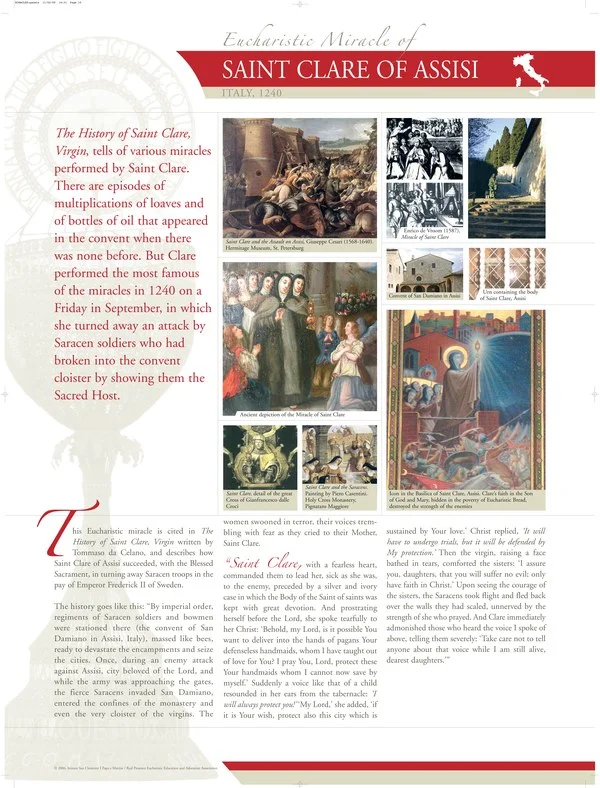
MIRACLES-panels 11/02/08 14:31 Page 10 The History Ofsaint Clare, Virgin, tells of various miracles performed by Saint Clare, There are episodes of multiplications of loaves and of bottles of oil that appeared in the convent when there was none before, But Clare performed the most famous of the miracles in 1240 on a Friday in September, in which she turned away an attack by Saracen soldiers who had broken into the convent cloister by showing them the Sacred Host, his Eucharistic miracle is cited in The History of Saint Clare, Virgin written by Tommaso da Celano, and describes how Saint Clare of Assisi succeeded, with the Blessed Sacrament, in turning away Saracen troops in the pay of Emperor Frederick II of Sweden. The history goes like this: "By imperial order, regiments of Saracen soldiers and bowmen were stationed there (the convent of San Damiano in Assisi, Italy), massed like bees, ready to devastate the encampments and seize the cities. Once, during an enemy attack against Assisi, city beloved of the Lord, and while the army was approaching the gates the fierce Saracens invaded San Damiano, entered the confines of the monastery and even the very cloister of the virgins.
The ITALY, 1240 Pignataro Maggiore bling with fear as they cried to their Mother, Saint Clare. with a fearless heart, commanded them to lead her, sick as she was, to the enemy, preceded by a silver and ivory case in which the Body of the Saint of saints was kept with great devotion. And prostrating herself before the Lord, she spoke tearfully to her Christ: 'Behold, my Lord, is it possible You want to deliver into the hands of pagans Your defenseless handmaids, whom I have taught out of love for You?
I pray You, Lord, protect these Your handmaids whom I cannot now save by myself.' Suddenly a voice like that of a child resounded in her ears from the tabernacle: 'I will always protect you! 'My Lord,' she added, 'if it is Your wish, protect also this city which is My protection. ' Then the virgin, raising a face bathed in tears, comforted the sisters: I assure you, daughters, that you will suffer no evil; only have faith in Christ.' Upon seeing the courage of the sisters, the Saracens took flight and fled back over the walls they had scaled, unnerved by the strength of she who prayed.
And Clare immediately admonished those who heard the voice I spoke of above, telling them severely: 'Take care not to tell anyone about that voice while I am still alive, dearest daughters."'
🔬 Scientific & Forensic Investigation
Rigorous histological, immunological and chromatographic analysis verified authentic human tissue with no chemical preservatives.
Relic Gallery & Historical Records
Fotografias em alta definição das sagradas relíquias, basílicas e documentos históricos catalogados por São Carlo Acutis. Clique para ampliar.

The Basilica and Convent of San Damiano in Assisi, where Saint Clare confronted the invading army in 1240

Enrico de Vroom (1587), Miracle of Saint Clare Convent of San Damiano in Assisi

Saint Clare and the Assault on Assisi, Giuseppe Cesari (1568-1640). Hermitage Museum, St. Petersburg

Saint Clare holding the monstrance containing the Blessed Sacrament from the convent window, putting the Saracen troops to flight

Urn containing the body of Saint Clare, Assisi

Icon in the Basilica of Saint Clare, Assisi. Clare's faith in the Son of God and Mary, hidden in the poverty of Eucharistic Bread, destroyed the strength of the enemies sustained by Your love.' Christ replied, 'It will have to undergo trials, but it will be defended by

Historical artwork and preserved documentation of the Eucharistic Miracle of Assisi (St. Clare) (1240)

Ancient depiction of the Miracle of Saint Clare

Saint Clare and the Saracens. Painting by Piero Casentini. Holy Cross Monastery,

Saint Clare, detail of the great Cross of Gianfrancesco dalle Croci women swooned in terror, their voices trem-
Original Exhibition Panels by Saint Carlo Acutis (300 DPI)
Inspecione a composição gráfica original em alta resolução (300 DPI, formato 60×80 cm), com o design e tipografia preservados exatamente como idealizados pelo autor.