Highlights
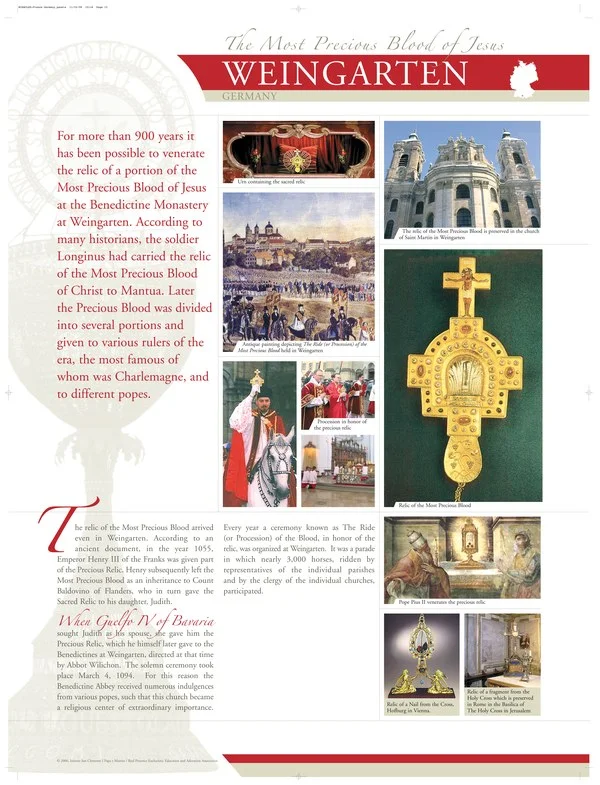
MIRACLES—France Germany panels 11/02/08 10 : 34 Page 15 For more than 900 years it has been possible to venerate the relic of a portion of the Most Precious Blood of Jesus at the Benedictine Monastery at Weingarten, According to many historians, the soldier Longinus had carried the relic of the Most Precious Blood of Christ to Mantua, Later the Precious Blood was divided into several portions and given to various rulers of the era, the most famous of whom was Charlemagne, and to different popes, he relic of the Most Precious Blood arrived even in Weingarten. According to an ancient document, in the year 1055, Emperor Henry III of the Franks was given part of the Precious Relic. Henry subsequently left the Most Precious Blood as an inheritance to Count Baldovino of Flanders, who in turn gave the Sacred Relic to his daughter, Judith.
sought Judit as IS spouse, e gave him the Precious Relic, which he himself later gave to the Benedictines at Weingarten, directed at that time by Abbot Wilichon. The solemn ceremony took place March 4, 1094. For this reason the Benedictine Abbey received numerous indulgences from various popes, such that this church became a religious center of extraordinary importance.
Urn containing the sacred relic The relic of the Most Precious Blood is preserved in the church of Saint Martin in Weingarten Antique painting depicting The Ride (or Procession) of the Most Precious Blood held in Weingarten Procession in honor of the precious relic Every year a ceremony known as The Ride (or Procession) of the Blood, in honor of the relic, was organized at Weingarten. It was a parade in which nearly 3,000 horses, ridden by representatives of the individual parishes and by the clergy of the individual churches, participated. Relic of the Most Precious Blood Pope Pius II venerates the precious relic Relic of a Nail from the Cross, Hofburg in Vienna.
Relic of a fragment from the Holy Cross which is preserved in Rome in the Basilica of The Holy Cross in Jerusalem MIRACLES—France Germany panels 11/02/08 10 : 34 Page 16 Procession / arms artew. The relic of the Most Precious Blood of Jesus is preserved in the Basilica of Sant'Andrea in Mantua Kunsthistorisches Museum, Vienna A letter from 1278, dated March 1st, in which Albert, abbot of the Benedictine Monastery of Sant'Andrea in Mantua, confirms the Mantuan origin of the relic of the Precious Blood of Jesus, preserved in the monastery at Weingarten estos Relics of the Holy Blood, Mantua Procession in honor of the Holy Blood at Mantua Twinning between the cities of Mantua and Weingarten Monstrances containing some relics of the Passion of Christ, Kunsthistorishces Museum, Vienna Relic of the Sacred Lance with which the Roman soldier struck the side of Jesus. Kunsthistorisches Museum, Vienna The relic of the Precious Blood (17th century).
City Hall at Weingarten Reliquary containing the soil on which the Most Precious Blood of Christ fell from the Cross, Czestochowa, Poland
🔬 Scientific & Forensic Investigation
Rigorous histological, immunological and chromatographic analysis verified authentic human tissue with no chemical preservatives.
Relic Gallery & Historical Records
Fotografias em alta definição das sagradas relíquias, basílicas e documentos históricos catalogados por São Carlo Acutis. Clique para ampliar.

The relic of the Most Precious Blood preserved in the Basilica of Saint Martin in Weingarten

Historical painting of Pope Pius II venerating the precious relic of the Holy Blood

Antique painting depicting 'The Blood Ride' (Blutritt) equestrian procession in Weingarten

Urn and reliquary casket containing the sacred portion of the Precious Blood of Jesus

The annual Blutritt ceremony with 3,000 riders in honor of the Holy Blood in Weingarten

Benedictine monks in solemn procession with the precious relic through the abbey grounds

Gilded reliquary cross preserving the Sacred Blood of Christ in Weingarten

Monumental Baroque Basilica of Saint Martin at Weingarten Abbey, Upper Swabia

Relic of a fragment of the True Cross preserved in the Basilica of the Holy Cross in Jerusalem, Rome

Relic of a Holy Nail from the Cross of Christ preserved in the Hofburg Treasury in Vienna

Relics of the Holy Blood preserved in the Basilica of Sant'Andrea in Mantua

17th-century silver reliquary of the Precious Blood preserved at Weingarten City Hall

Historical letter (1 March 1278) from Abbot Albert of Mantua confirming the authenticity of the Weingarten relic

The Basilica of Sant'Andrea in Mantua where the Longinus relic of the Precious Blood is honored

Statue of Saint Longinus carrying the vessel with the Precious Blood to Mantua

Reliquary containing the sacred earth stained by the Precious Blood of Christ from the Cross (Czestochowa, Poland)

Solemn procession and civic twinning between the cities of Mantua and Weingarten

Emperor Henry III presenting the Precious Blood relic to Count Baldwin of Flanders in 1055

Monstrances and reliquaries containing Passion relics in the Kunsthistorisches Museum, Vienna

Relic of the Holy Lance of Longinus preserved in the Imperial Treasury (Hofburg) in Vienna

Abbot Wilichon receiving the sacred relic from Duchess Judith on 4 March 1094

Baroque fresco on the vault of Weingarten Basilica depicting the history of the Holy Blood

Imperial regalia and reliquaries of the Holy Roman Empire preserved in Vienna
Original Exhibition Panels by Saint Carlo Acutis (300 DPI)
Inspecione a composição gráfica original em alta resolução (300 DPI, formato 60×80 cm), com o design e tipografia preservados exatamente como idealizados pelo autor.