Highlights
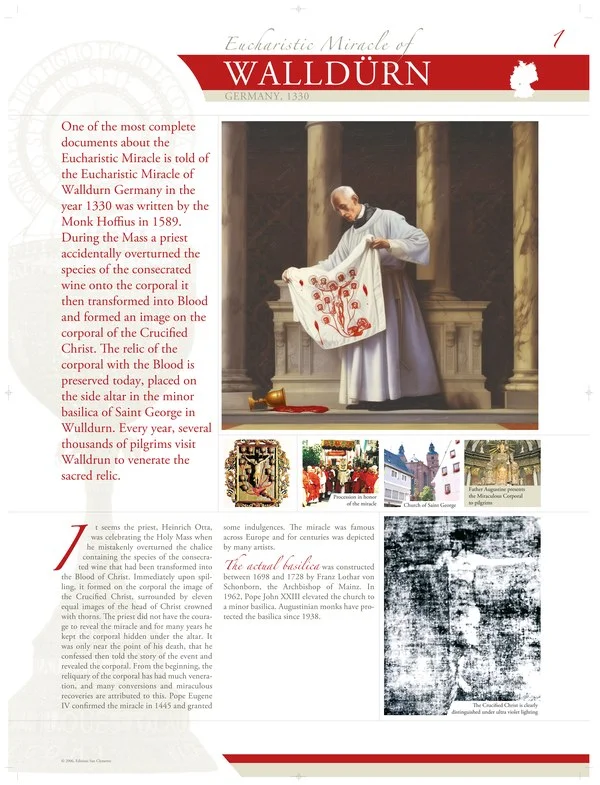
One of the most complete documents about the Eucharistic Miracle is told of the Eucharistic Miracle of Walldurn Germany in the year 1330 was written by the Monk in 1589, During the Mass a priest accidentally overturned the species of the consecrated wine onto the corporal it then transformed into Blood and formed an image on the corporal of the Crucified Christ, The relic of the corporal with the Blood is preserved today, placed on the side altar in the minor basilica of Saint George in Wulldurn, Every year, several thousands of pilgrims visit Walldrun to venerate the sacred relic, t seems the priest, Heinrich Otta, was celebrating the Holy Mass when he mistakenly overturned the chalice containing the species of the consecra- ted wine that had been transformed into the Blood of Christ. Immediately upon spil- ling, it formed on the corporal the image of the Crucified Christ, surrounded by eleven equal images of the head of Christ crowned with thorns. The priest did not have the coura- ge to reveal the miracle and for many years he kept the corporal hidden under the altar.
It was only near the point of his death, that he confessed then told the story of the event and revealed the corporal. From the beginning, the reliquary of the corporal has had much venera- tion, and many conversions and miraculous recoveries are attributed to this. Pope Eugene IV confirmed the miracle in 1445 and granted WALLDÜRN by many artists.
was constructed between 1698 and 1728 by Franz Lothar von Schonborn, the Archbishop of Mainz. In 1962, Pope John XXIII elevated the church to a minor basilica. Augustinian monks have pro- tected the basilica since 1938. WALLDÜRN •ttt:
Relic Gallery & Historical Records
Fotografias em alta definição das sagradas relíquias, basílicas e documentos históricos catalogados por São Carlo Acutis. Clique para ampliar.

Procession in honor of the miracle some indulgences. Elhe miracle was famous across Europe and for centuries was depicted

The Minor Basilica of Saint George and the Holy Blood in Walldürn, major pilgrimage center of Germany

Church of Saint George

Father Augustine presents the Miraculous Corporal to pilgrims

The Crucified Christ is clearly distinguished under ultra violet lighting

GERMANY, 1330

GERMANY, 1330

Father Heinrich Otto spilling the chalice and seeing the image of the Crucified Christ formed by the Blood on the corporal (1330)

Banner in the Church of Saint George

Church of Saint George

Banner in the Church of Saint George

Interior of the Church

Father Otto hides the miraculous

corporal. This painting is in the church of Saint George and was painted in 1732

Banner in the Church of Saint George

Banner in the Church of Saint George on which the miracle is presented
Original Exhibition Panels by Saint Carlo Acutis (300 DPI)
Inspecione a composição gráfica original em alta resolução (300 DPI, formato 60×80 cm), com o design e tipografia preservados exatamente como idealizados pelo autor.