Highlights
Listen
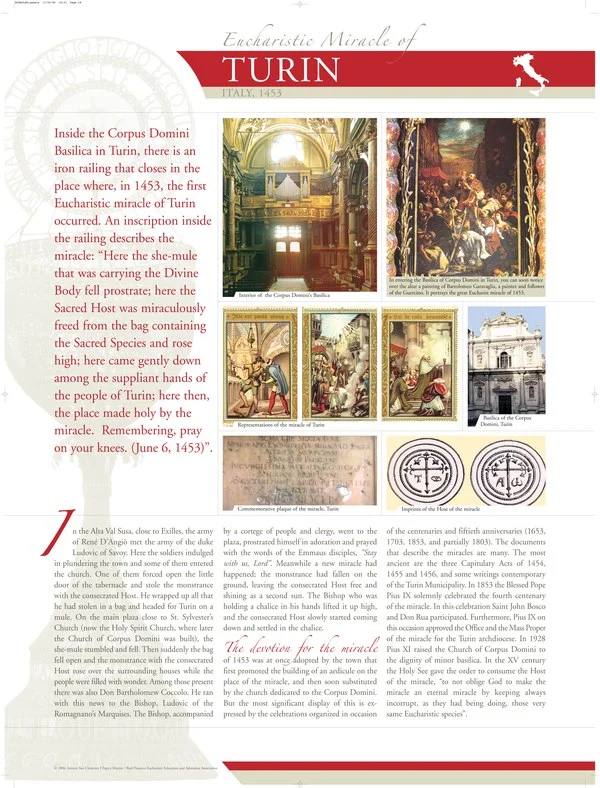
MIRACLES-panels 11/02/08 14:31 Page 19 Inside the Corpus Domini Basilica in Turin, there is an iron railing that closes in the place where, in 1453, the first Eucharistic miracle of Turin occurred, An inscription inside the railing describes the miracle: "Here the she-mule that was carrying the Divine Body fell prostrate; here the Sacred Host was miraculously freed from the bag containing the Sacred Species and rose high; here came gently down among the suppliant hands of the people of Turin; here then, the place made holy by the miracle, Remembering, pray on your knees, (June 6, 1453)" , n the Alta Val Susa, close to Exilles, the army of René D'Angiö met the army of the duke Ludovic of Savoy. Here the soldiers indulged in plundering the town and some of them entered the church. One of them forced open the little door of the tabernacle and stole the monstrance with the consecrated Host.
He wrapped up all that he had stolen in a bag and headed for Turin on a mule. On the main plaza close to St. Sylvester's Church (now the Holy Spirit Church, where later the Church of Corpus Domini was built), the she-mule stumbled and fell. Then suddenly the bag fell open and the monstrance with the consecrated Host rose over the surrounding houses while the people were filled with wonder.
Among those present there was also Don Bartholomew Coccolo. He ran with this news to the Bishop, Ludovic of the Romagnano's Marquises. The Bishop, accompanied ITALY, 1453 with the words of the Emmaus disciples, "Stay with us, Lord". Meanwhile a new miracle had happened; the monstrance had fallen on the ground, leaving the consecrated Host free and shining as a second sun.
The Bishop who was holding a chalice in his hands lifted it up high, and the consecrated Host slowly started coming down and settled in the chalice. Or t mzmcß of 1453 was at once dopted by the town that first promoted the building of an aedicule on the place of the miracle, and then soon substituted by the church dedicated to the Corpus Dominie But the most significant display of this is ex- pressed by the celebrations organized in occasion Imprints of the Host of the miracle of the centenaries and fiftieth anniversaries (1653, 1703, 1853, and partially 1803). The documents that describe the miracles are many.
The most ancient are the three Capitulary Acts of 1454, 1455 and 1456, and some writings contemporary of the Turin Municipality. In 1853 the Blessed Pope Pius IX solemnly celebrated the fourth centenary of the miracle. In this celebration Saint John Bosco and Don Rua participated.
Furthermore, Pius IX on this occasion approved the Office and the Mass Proper of the miracle for the Turin archdiocese. In 1928 Pius XI raised the Church of Corpus Domini to the dignity of minor basilica. In the XV century the Holy See gave the order to consume the Host of the miracle, "to not oblige God to make the miracle an eternal miracle by keeping always incorrupt, as they had being doing, those very same Eucharistic species".
MIRACLES-panels 11/02/08 14:32 Page 20 mwzstrauce (Uit t consecrat /Ztrost rose oper t arere a aze e tern o nti'zacodo cot "1 ante net & g empte 01 cot'zotte, come specie ITALY, 1453 s ACRA ,EOXCVI.A removed from the tabernacle in 1492 when the works for the construction of the new edifice, planned by Meo del Caprino, were started. In 1528, on the spot where the miraculous event took place, the aedicule of Matthew Sanmicheli was built. It was decorated with paintings that were recalling the most important phases of the event.
This edifice was replaced by the present church of Corpus Domini, which was started by Ascanio Vittozzi in 1604. The building of Corpus Domini was decided by the municipality in 1598 during the epidemic of the plague, and also to answer to a request made by the Host taken from the miracle of Turin illustrated on the occasion of the first international Eucharistic congress, Turin, Canonica Brothers Typography, 1894 (Simeon Collection, c 9200) Chalice of the miracle of Turin Plaque where the mule fell down Anonymous, Miracle of the Blessed Sacrament, occurred in the very famous and glorious town of Turin, in the year 1453 on June 6 about 8:00 P.M., engraved plate attached to The Secular Year (Simeon Collection C 2412). The triptych illustrates the salient phases of the event: of the she-mule, the ascension of the Host, and its depositing into the chalice.
The two lateral arches are surmounted by the city's coat of arms. The iron with which the miraculous Host had been engraved was transferred to Turin from Exilles in 1673 and in 1684 it was donated to the municipality that still today keeps it among the deposits of the municipality's historic archives. MIRACLES-panels 11/02/08 14:32 Page 28 During the invasion by Count Harcourt's army, the soldiers entered the Church of Ste Maria del Monte and killed many civilians, The lives of the Capuchin friars, however, were spared, A French soldier succeeded in opening the tabernacle which contained a ciborium with several consecrated Hosts.
Flames of fire miraculously blazed out to envelop him - burning his face and his clothing, The door of the tabernacle which is adorned with agate and lapislazzuli or blue stones still shows the imprint of the soldier's scorched hand, n 1640, the French army of Count Harcourt crossed the River Po and advanced to the Capuchin Friars' Church of the Monte. Friar Pier Maria da Cambiano, a Capuchin friar, describes in great detail the Eucharistic miracle that occurred during the French troops' occupation of the Church of Santa Maria del Monte. was over- run wi h oreign tr ops.
After Casale Monferrato was liberated from the Spaniards, the French advanced to Turin. On May 6, 1640 they arrived at Chieri, on the 7th at Moncalieri, and on the 10th they finally reached Turin. Having occupied the left bank of the Po River, they launched an offensive attack and gained control of the bridge.
From there they advanced to the Capuchin Monastery of the Monte. However, it was not that ITALY, 1640 They were twice repelled. On the third assault, however, our troops were compelled to lay down their arms and flee with the civilian population to seek shelter and safety in the sanctuary of a holy place the church.
The invaders, nevertheless, entered the church and slaughtered the men and women, the young and the old, civilians and troops alike; even those who braced themselves onto the altars or who took refuge in the arms of the Capuchin friars. They pleaded for their lives and for their freedom. None of the friars were wounded but their hearts were distraught at the sight of so much bloodshed and carnage.
The soldiers trashed sacred vessels and vestments for safe keeping. And after, in the church itself (too horrible to recount!) they committed brutal acts of debauchery! As if all that were not enough, a French soldier, who was an unbeliever, climbed onto the altar and forced open the tabernacle to seize the cibo- rium and the sacred Hosts it held in order to desecrate the Hosts.
And then, a miracle!! A flame of fire blazed out of the ciborium directly onto the sacrilegious Frenchman; it scorched his uniform and his face! The terrified soldier threw himself to the floor screaming and asking God's forgiveness. The church was suddenly filled with dense smoke.
Between the terror and the astonishment felt by all, the vandalism ceased!
🔬 Scientific & Forensic Investigation
Rigorous histological, immunological and chromatographic analysis verified authentic human tissue with no chemical preservatives.
Relic Gallery & Historical Records
Fotografias em alta definição das sagradas relíquias, basílicas e documentos históricos catalogados por São Carlo Acutis. Clique para ampliar.

Interior of the Corpus Domini's Basilica Representations of the miracle of Turin

Detail of the marble column marking the exact spot where the miraculous Host hovered

over the altar a painting of Bartolomeo Garavaglia, a painter and follower of the Guercino. It portrays the great Eucharist miracle of 1453.

y-Cic est pani5 vivu$ :.é:

Commemorative plaque of the miracle, Turin by a cortege of people and clergy, went to the plaza, prostrated himself in adoration and prayed

Basilica of the Corpus

In entering the Basilica of Corpus Domini in Turin, you can soon notice Qui be cdo begcenbit..é:

Domini, Turin

documents about the miracle

// 6 d no t46(b. Reproduction of the miraculous

the stealing of the consecrated Host at Exilles, the falling down

G.A. Recchi, frescoes that describe the miracle and that are at the town hall of Turin pet "t Olt 066di5aze

Painting depicting Bishop Ludovico da Romagnano presenting the chalice to the descending Host

Luigi Vacca (1853), frescoes that decorate the basilica's vault and illustrate the stages of the miracle Box of cypress made by the town of Turin in 1672 to keep the

ten net o, ciaetle s tesse e acatistiche Plaque on which it is said that the Host of the miracle was consumed, "to not oblige God to perform an eternal miracle... "

Holy Spirit Confraternity. Interior of Corpus Domini's Basilica

Historical artwork and preserved documentation of the Eucharistic Miracle of Turin (1453, 1640)

Monumental high altar and canopy inside the Basilica of Corpus Domini in Turin

Commemorative marble plaque in Piazza Corpus Domini recording the miracle of 6 June 1453

To house the miraculous Host, a tabernacle was built in the cathedral in 1455. The miraculous Host was

Historical print depicting the crowds gathered in wonder before the radiant suspended Host

Ceiling fresco in the Basilica of Corpus Domini depicting the heavenly light of the miracle

The Capuchin Church of the Monte IN scrRA $VA„Å Antique painting of the Del Monte of the Capuchins at Turin

Ancient painting exhibited in the Church portraying the miracle

Tabernacle of the Church of San Francesco da Paola unharmed during the 1706 French siege

Historical painting commemorating the preservation of the Holy Sacrament in Turin (1706)

The high altar of San Francesco da Paola where the miraculous tabernacle is venerated

Interior of the Church secure a position. On the morning of May 12, they launched a double attack on the trenches.

Detail of the tabernacle of the miracle

and they sacked the friary since the refugees had stored some of their household items and furniture
Original Exhibition Panels by Saint Carlo Acutis (300 DPI)
Inspecione a composição gráfica original em alta resolução (300 DPI, formato 60×80 cm), com o design e tipografia preservados exatamente como idealizados pelo autor.