Highlights
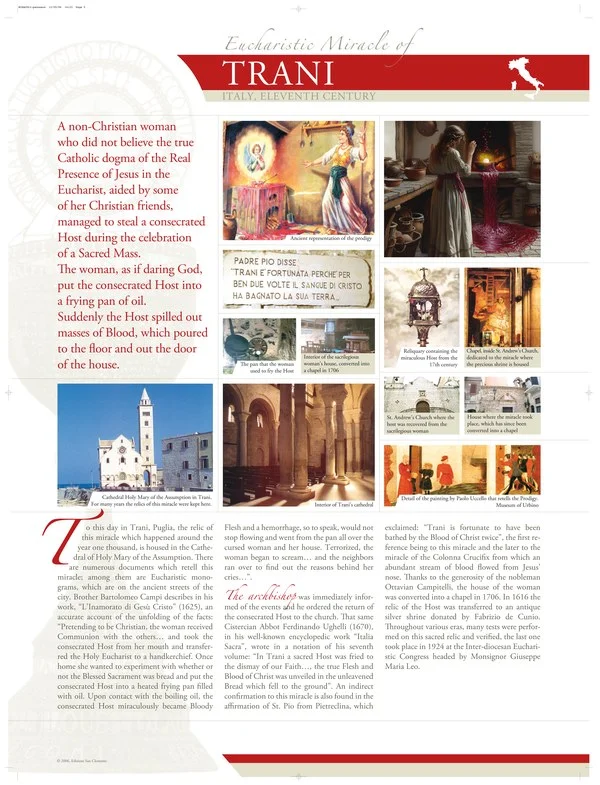
MIRACOLI—panneaux 12/05/06 14 : 33 Page 5 A non-Christian woman who did not believe the true Catholic dogma of the Real Presence of Jesus in the Eucharist, aided by some of her Christian friends, managed to steal a consecrated Host during the celebration of a Sacred Mass. The woman, as if daring God, put the consecrated Host into a frying pan of oil, Suddenly the Host spilled out masses of Blood, which poured to the floor and out the door year one thousand, is housed in the Cathe- dral of Holy Mary of the Assumption. There are numerous documents which retell this miracle; among them are Eucharistic mono- grams, which are on the ancient streets of the work, "L'lnamorato di Gesu Cristo" (1625), an accurate account of the unfolding of the facts: "Pretending to be Christian, the woman received Communion with the others.
and took the consecrated Host from her mouth and transfer- red the Holy Eucharist to a handkerchief. Once home she wanted to experiment with whether or not the Blessed Sacrament was bread and put the consecrated Host into a heated frying pan filled with oil. Upon contact with the boiling oil, the consecrated Host miraculously became Bloody "TRANI E' FORTUNÅTA PERCHE' PER iiiiiid cursed woman and her house.
Terrorized, the woman began to scream. and the neighbors ran over to find out the reasons behind her cries... was immediately infor- med of the events d he ordered the return of the consecrated Host to the church. That same Cistercian Abbot Ferdinando Ughelli (1670), in his well-known encyclopedic work "Italia Sacra", wrote in a notation of his seventh volume: "In T rani a sacred Host was fried to the dismay of our Faith..
o, the true Flesh and Blood of Christ was unveiled in the unleavened Bread which fell to the ground". An indirect confirmation to this miracle is also found in the affirmation of St. Pio from Pietreclina, which exclaimed: "T rani is fortunate to have been bathed by the Blood of Christ twice", the first re- ference being to this miracle and the later to the miracle of the Colonna Crucifix from which an abundant stream of blood flowed from Jesus' nose.
Thanks to the generosity of the nobleman Ottavian Campitelli, the house of the woman was converted into a chapel in 1706. In 1616 the relic of the Host was transferred to an antique silver shrine donated by Fabrizio de Cunio. Throughout various eras, many tests were perfor- med on this sacred relic and verified, the last one took place in 1924 at the Inter-diocesan Euchari- stic Congress headed by Monsignor Giuseppe Maria Leo.
🔬 Scientific & Forensic Investigation
Rigorous histological, immunological and chromatographic analysis verified authentic human tissue with no chemical preservatives.
Relic Gallery & Historical Records
Fotografias em alta definição das sagradas relíquias, basílicas e documentos históricos catalogados por São Carlo Acutis. Clique para ampliar.

Ancient representation of the prodigy PADRE Pio DISSE

woman's house, converted into The pan that the woman a chapel in 1706 used to fry the Host Interior of T rani's cathedral Flesh and a hemorrhage, so to speak, would not stop flowing and went from the pan all over the

Chapel, inside St. Andrew's Church, dedicated to the miracle where the precious shrine is housed

House where the miracle took place, which has since been converted into a chapel

miraculous Host from the 17th century St. Andrew's Church where the host was recovered from the sacrilegious woman

HA BAGNATO LA SUA TERRA., Interior of the sacrilegious

Historical artwork and preserved documentation of the Eucharistic Miracle of Trani (11th Century)

BEN DUE VOLTE IL SANOE Dl CRISTO

Detail of the painting by Paolo Uccello that retells the Prodigy. Museum of Urbino

Reliquary containing the

Gilded reliquary and sacred relic preserved from the Eucharistic Miracle of Trani (11th Century)

of the house, Cathedral Holy Mary of the Assumption in Trani. For many years the relics of this miracle were kept here. o this day in Trani, Puglia, the relic of this miracle which happened around the
Original Exhibition Panels by Saint Carlo Acutis (300 DPI)
Inspecione a composição gráfica original em alta resolução (300 DPI, formato 60×80 cm), com o design e tipografia preservados exatamente como idealizados pelo autor.