Destaques
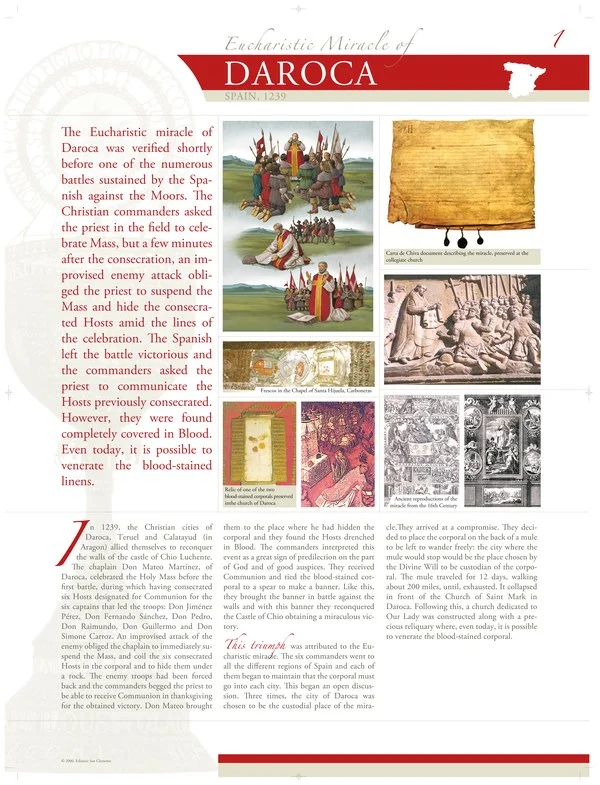
O Milagre Eucarístico de Daroca verificou-se pouco antes de uma das numerosas batalhas travadas pelos Espanhóis contra os Mouros, os comandantes cristãos pediram ao padre no campo que celebrasse a Missa, mas poucos minutos depois da consagração, um ataque inimigo improvisado obrigou o padre a suspender a Missa e a esconder as Hóstias consagradas no meio das linhas da celebração. Hóstias anteriormente consagradas, porém, foram encontradas completamente cobertas de Sangue, Ainda hoje é possível venerar os lençóis manchados de sangue. m 1239, as cidades cristãs de Daroca, Teruel e Calatayud (em Aragão) aliaram-se para reconquistar as muralhas do castelo de Chio Luchente. O capelão Don Mateo Martinez, de Daroca, celebrou a Santa Missa antes da primeira batalha, durante a qual tendo consagrado seis Hóstias designadas para a Comunhão para os seis capitães que lideravam as tropas: Don Jiménez Pérez, Don Fernando Sånchez, Don Pedro, Don Raimundo, Don Guillermo e Don inimigo obrigou o capelão a suspender imediatamente a Missa, e enrolar as seis Hóstias consagradas no corporal e escondê-las debaixo de uma pedra.
The enemy troops had been forced back and the commanders begged the priest to be able to receive Communion in thanksgiving for the obtained victory. Don Mateo brought Etoe L/"östöe SPAIN, 1239 Frescos in the Chapel of Santa Hijuela, Carboneras : .14 f' relíquia of one of the two blood-stained corporals preserved inthe church of Daroca them to the place where he had hidden the corporal and they found the Hosts drenched in Blood. The commanders interpreted this event as a great sign of predilection on the part of God and of good auspices.
Receberam a Comunhão e amarraram o cabo ensanguentado a uma lança para fazer um estandarte. Assim, trouxeram o estandarte em batalha contra as muralhas e com este estandarte reconquistaram o Castelo de Chio obtendo uma vitória milagrosa. foi atribuído à mira eucarística e.
six commanders went to all the different regions of Spain and each of them began to maintain that the corporal must go into each city. This began an open discus- sion. Three times, the city of Daroca was chosen to be the custodial place of the mira- Carta de Chiva document describing the miracle, preserved at the collegiate church LOS SANCTISSIMOS DELA V DAD DE DAPOCCA ere.- Ancient reproductions of the JT miracle from the 16th Century cle.They arrived at a compromise.
They deci- ded to place the corporal on the back of a mule to be left to wander freely: the city where the mule would stop would be the place chosen by the Divine Will to be custodian of the corpo- ralo The mule traveled for 12 days, walking about 200 miles, until, exhausted. It collapsed in front of the Church of Saint Mark in Daroca. Following this, a church dedicated to Our Lady was constructed along with a pre- cious relicário where, even today, it is possible to venerate the blood-stained corporal.
/Ztros6 eze Panoramic view of the church in Daroca Chapel of Los Corporales Flhe Holy Hijuela (Pall) is one of the corporals of the miracle and is preserved at Carboneras Etoe L/"östöe SPAIN, 1239 Ancient pictures depicting the miracle Chapel where the Santa Hijuela Main altar of the (Pall) is preserved, Carboneras church of Daroca Procession held every year in honor of the miracle of Daroca Santa Maria Basilica, Daroca Interior of the church Wall paintings in the Chapel of Los Corporales describing the miracle
Galeria de Relíquias & Registros Históricos
Fotografias em alta definição das sagradas relíquias, basílicas e documentos históricos catalogados por São Carlo Acutis. Clique para ampliar.

Afrescos na Capela de Santa Hijuela, Carboneras de Guadazaón

relíquia of one of the two blood-stained corporals preserved in the Collegiate Church of Daroca

Gravura antiga do século XVI ilustrando a vitória milagrosa dos comandantes cristãos sob a bandeira eucarística

Historical 'Carta de Chiva' document (1340) chronicling O Milagre Eucarístico of the Holy Corporals

Retábulo de prata em relevo representando 'Los Santíssimos Corporales de la Ciudad de Daroca'

Iluminação antiga mostrando a mula errante carregando os Santos Cabos em direção a Daroca

O Capelão Don Mateo Martínez encontra as seis Hóstias consagradas encharcadas de Sangue vivo debaixo da rocha

Gothic processional relicário of the Holy Corporals (Los Corporales de Daroca)

Main Baroque altar of the Basilica of Santa María in Daroca with the tabernáculo of the miracle

A Capela de Los Corporales dentro da Basílica de Santa María em Daroca

Pintura antiga representando a batalha de Chio Luchente e a reconquista sob o sinal milagroso

Wall frescoes in the Chapel of Los Corporales narrating the miraculous translation of the Sacred relíquias

Torre gótica monumental e fachada exterior da Basílica de Santa María, Daroca

Vista panorâmica da histórica cidade medieval e das muralhas da fortaleza de Daroca

Capela de Santa Hijuela em Carboneras de Guadazaón onde se conserva o segundo linho milagroso

Nave interior da Igreja Paroquial de Carboneras de Guadazaón

Solene procissão anual de Corpus Christi com os Santos Cabos pelas ruas de Daroca

Cena 1 do afresco: Capelão Don Mateo celebrando missa antes da batalha contra os mouros

Fresco scene 2: The sudden enemy attack forcing the priest to wrap the Hóstias Consagradas in the corporal

Cena 3 do afresco: O padre escondendo o cabo sagrado sob uma pedra durante o combate

Cena 4 do afresco: Os comandantes descobrem as seis Hóstias sangrando sobre o cabo

Cena 5 do afresco: O cabo manchado de sangue amarrado a uma lança e carregado como estandarte vitorioso

Fresco scene 6: Dispute among the cities of Daroca, Teruel and Calatayud over the custody of the relíquia

Fresco scene 7: The mule bearing the Holy corporal wandering 200 miles across Aragon

Cena 8 do afresco: A mula desabando em frente à Igreja de São Marcos em Daroca

Vista panorâmica da cidade de Daroca e da colegiada de Santa María

relicário bust and commemorative statue of Chaplain Don Mateo Martínez

A Santa Hijuela (Pall) de Carboneras de Guadazaón, um dos dois milagrosos lençóis manchados de sangue de 1239
Painéis Originais de Exposição de São Carlo Acutis (300 DPI)
Inspecione a composição gráfica original em alta resolução (300 DPI, formato 60×80 cm), com o design e tipografia preservados exatamente como idealizados pelo autor.