Destaques
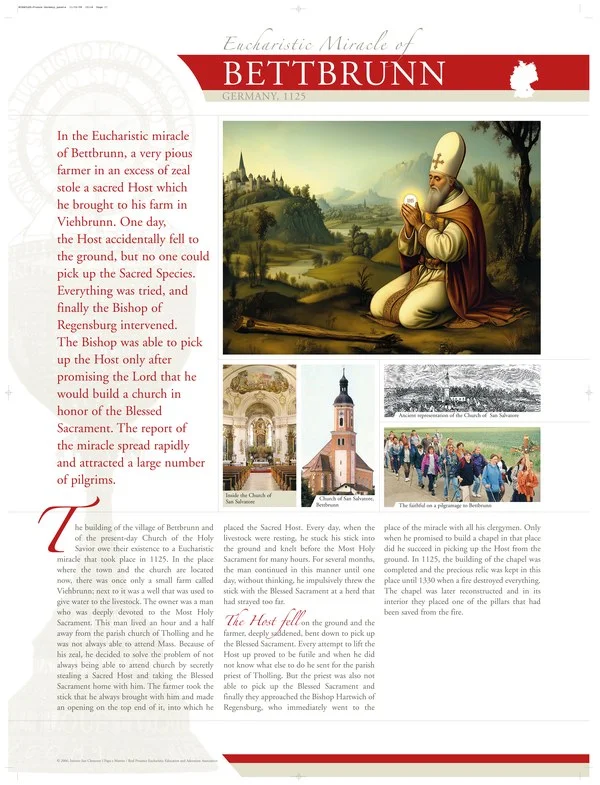
MILAGRES — França Alemanha painéis 11/02/08 10 : 34 Page 17 No milagre eucarístico de Bettbrunn, um agricultor muito piedoso e com excesso de zelo roubou uma Hóstia sagrada que trouxe para sua fazenda em Viehbrunn. Um dia, a Hóstia caiu acidentalmente no chão, mas ninguém conseguiu pegar as Espécies Sagradas, Tudo foi tentado, e finalmente o Bispo de Regensburg interveio, O Bispo conseguiu pegar a Espécie Sagrada Anfitrião somente depois de prometer ao Senhor que construiria uma igreja em homenagem ao Santíssimo Sacramento, A notícia do milagre se espalhou rapidamente e atraiu um grande número de peregrinos, a construção da vila de Bettbrunn e da atual Igreja do Santo Salvador deve sua existência a um milagre eucarístico ocorrido em 1125. No local onde hoje estão localizadas a cidade e a igreja, existia apenas uma pequena fazenda chamada Viehbrunn; ao lado havia um poço que servia para dar água ao gado. O proprietário era um homem profundamente devoto do Santíssimo Sacramento.
This man lived an hour and a half away from the parish church of Tholling and he was not always able to attend Mass. Because of his zeal, he decided to solve the problem of not always being able to attend church by secretly stealing a Sacred Host and taking the Santíssimo Sacramento home with him. The farmer took the stick that he always brought with him and made an opening on the top end of it, into which he GERMANY, 1125 Ancient representation of the Church of San Salvatore Inside the Church of San Salvatore placed the Sacred Host.
Church of San Salvatore, Bettbrunn Every day, when the livestock were resting, he stuck his stick into the ground and knelt before the Most Holy Sacrament for many hours. For several months, the man continued in this manner until one day, without thinking, he impulsively threw the stick with the Santíssimo Sacramento at a herd that had strayed too far. on the ground and the farmer, deepl s ddened, bent down to pick up the Santíssimo Sacramento.
Every attempt to lift the Host up proved to be futile and when he did not know what else to do he sent for the parish priest of Tholling. But the priest was also not able to pick up the Santíssimo Sacramento and finally they approached the Bishop Hartwich of Regensburg, who immediately went to the The faithful on a pilgramage to Bettbrunn place of the miracle with all his clergymen. Only when he promised to build a chapel in that place did he succeed in picking up the Host from the ground.
In 1125, the building of the chapel was completed and the precious relíquia was kept in this place until 1330 when a fire destroyed everything. The chapel was later reconstructed and in its interior they placed one of the pillars that had been saved from the fire. wristie GERMANY, 1125 Sthulbus
🔬 Investigação Científica & Forense
Rigorosas análises histológicas, imunológicas e cromatográficas verificaram tecido humano autêntico, sem conservantes químicos.
Galeria de Relíquias & Registros Históricos
Fotografias em alta definição das sagradas relíquias, basílicas e documentos históricos catalogados por São Carlo Acutis. Clique para ampliar.

Antiga representação da Igreja de San Salvatore em Bettbrunn

afresco histórico representando fiéis em peregrinação a Bettbrunn

A torre da igreja do Santuário do Santo Salvador (San Salvatore) em Bettbrunn

Vista interior da Igreja de San Salvatore em Bettbrunn

Baroque high altar and sanctuary where the Eucharistic relíquia of 1125 is honored

Pintura votiva que comemora o milagre eucarístico da Hóstia roubada em 1125

Gilded relicário preserved within the parish church of Bettbrunn

Elaborado afresco no teto representando a tradução solene da Hóstia Sagrada pelo Bispo de Regensburg

Ilustração histórica do Bispo Hartwich de Regensburg ajoelhado em oração diante da Hóstia imóvel

Processional banner and altar painting depicting the shepherd kneeling before the Santíssimo Sacramento

Coluna histórica preservada do incêndio de 1330 integrada na capela reconstruída

Área do santuário e complexo de peregrinação de Bettbrunn, Baviera
Painéis Originais de Exposição de São Carlo Acutis (300 DPI)
Inspecione a composição gráfica original em alta resolução (300 DPI, formato 60×80 cm), com o design e tipografia preservados exatamente como idealizados pelo autor.