In Evidenza
Il miracolo eucaristico di Daroca si verificò poco prima di una delle numerose battaglie sostenute dagli spagnoli contro i mori, i comandanti cristiani chiesero al sacerdote sul campo di celebrare la Messa, ma pochi minuti dopo la consacrazione, un improvvisato attacco nemico obbligò il sacerdote a sospendere la Messa e a nascondere le Particole consacrate tra le file della celebrazione. Gli spagnoli uscirono vittoriosi dalla battaglia e i comandanti chiesero al sacerdote di comunicare preventivamente le Particole. consacrati, furono però ritrovati completamente ricoperti di Sangue. Ancora oggi è possibile venerare i lini macchiati di sangue. el 1239, le città cristiane di Daroca, Teruel e Calatayud (in Aragona) si allearono per riconquistare le mura del castello di Chio Luchente. Il cappellano Don Mateo Martinez, di Daroca, celebrò la Santa Messa prima della prima battaglia, durante la quale dopo aver consacrato sei Particole destinate alla Comunione per i sei capitani che guidavano le truppe: Don Jiménez Pérez, Don Fernando Sånchez, Don Pedro, Don Raimundo, Don Guillermo e Don nemico obbligò il cappellano a sospendere immediatamente la Messa, ad avvolgere le sei Particole consacrate nel corporalee e a nasconderle sotto una roccia.
The enemy troops had been forced back and the commanders begged the priest to be able to receive Communion in thanksgiving for the obtained victory. Don Mateo brought Etoe L/"östöe SPAIN, 1239 Frescos in the Chapel of Santa Hijuela, Carboneras : .14 f' reliquia of one of the two blood-stained corporals preserved inthe church of Daroca them to the place where he had hidden the corporale and they found the Hosts drenched in Blood. The commanders interpreted this event as a great sign of predilection on the part of God and of good auspices.
Ricevettero la Comunione e legarono il corpora- le macchiato di sangue a una lancia per farne uno stendardo. Portarono così il vessillo in battaglia contro le mura e con questo vessillo riconquistarono il Castello di Chio ottenendo una vittoria miracolosa. è stato attribuito al mira eucaristico.
six commanders went to all the different regions of Spain and each of them began to maintain that the corporale must go into each city. This began an open discus- sion. Three times, the city of Daroca was chosen to be the custodial place of the mira- Carta de Chiva document describing the miracle, preserved at the collegiate church LOS SANCTISSIMOS DELA V DAD DE DAPOCCA ere.- Ancient reproductions of the JT miracle from the 16th Century cle.They arrived at a compromise.
They deci- ded to place the corporale on the back of a mule to be left to wander freely: the city where the mule would stop would be the place chosen by the Divine Will to be custodian of the corpo- ralo The mule traveled for 12 days, walking about 200 miles, until, exhausted. It collapsed in front of the Church of Saint Mark in Daroca. Following this, a church dedicated to Our Lady was constructed along with a pre- cious reliquiario where, even today, it is possible to venerate the blood-stained corporale.
/Ztros6 eze Panoramic view of the church in Daroca Chapel of Los Corporales Flhe Holy Hijuela (Pall) is one of the corporals of the miracle and is preserved at Carboneras Etoe L/"östöe SPAIN, 1239 Ancient pictures depicting the miracle Chapel where the Santa Hijuela Main altare of the (Pall) is preserved, Carboneras church of Daroca Procession held every year in honor of the miracle of Daroca Santa Maria Basilica, Daroca Interior of the church Wall paintings in the Chapel of Los Corporales describing the miracle
Galleria di Reliquie e Documenti Storici
Fotografias em alta definição das sagradas relíquias, basílicas e documentos históricos catalogados por São Carlo Acutis. Clique para ampliar.

Affreschi nella Cappella di Santa Hijuela, Carboneras de Guadazaón

reliquia of one of the two blood-stained corporals preserved in the Collegiate Church of Daroca

Antica incisione del XVI secolo che illustra la miracolosa vittoria dei condottieri cristiani sotto il vessillo eucaristico

Historical 'Carta de Chiva' document (1340) chronicling Il Miracolo Eucaristico of the Holy Corporals

Pala d'altare in argento sbalzato raffigurante 'Los Santíssimos Corporales de la Ciudad de Daroca'

Antica miniatura raffigurante la mula errante che trasporta i Santi Caporali verso Daroca

Chaplain Don Mateo Martínez finding the six Ostie Consacrate drenched in living Blood under the rock

Gothic processional reliquiario of the Holy Corporals (Los Corporales de Daroca)

Main Baroque altare of the Basilica of Santa María in Daroca with the tabernacolo of the miracle

La Cappella dei Corporales all'interno della Basilica di Santa María a Daroca

Dipinto antico raffigurante la battaglia di Chio Luchente e la riconquista sotto il segno miracoloso

Wall frescoes in the Chapel of Los Corporales narrating the miraculous translation of the Sacred reliquie

Monumentale torre gotica e facciata esterna della Basilica di Santa María, Daroca

Vista panoramica della storica città medievale e delle mura della fortezza di Daroca

Cappella di Santa Hijuela a Carboneras de Guadazaón dove è conservato il secondo lino miracoloso

Navata interna della Chiesa Parrocchiale di Carboneras de Guadazaón

Solenne processione annuale del Corpus Domini con i Santi Corporali per le strade di Daroca

Affresco scena 1: Il cappellano Don Mateo celebra la messa prima della battaglia contro i Mori

Affresco scena 2: L'improvviso attacco nemico costringe il sacerdote ad avvolgere le Particole consacrate nel corporale

Fresco scene 3: The priest hiding the sacred corporale under a rock during the combat

Fresco scene 4: The commanders discovering the six Hosts bleeding upon the corporale

Fresco scene 5: The blood-stained corporale tied to a spear and carried as a victorious standard

Fresco scene 6: Dispute among the cities of Daroca, Teruel and Calatayud over the custody of the reliquia

Fresco scene 7: The mule bearing the Holy corporale wandering 200 miles across Aragon

Affresco scena 8: Il mulo crolla davanti alla Chiesa di San Marco a Daroca

Vista panoramica della città di Daroca e della collegiata di Santa María

reliquiario bust and commemorative statue of Chaplain Don Mateo Martínez

La Sacra Hijuela (Palla) di Carboneras de Guadazaón, uno dei due miracolosi lini macchiati di sangue del 1239
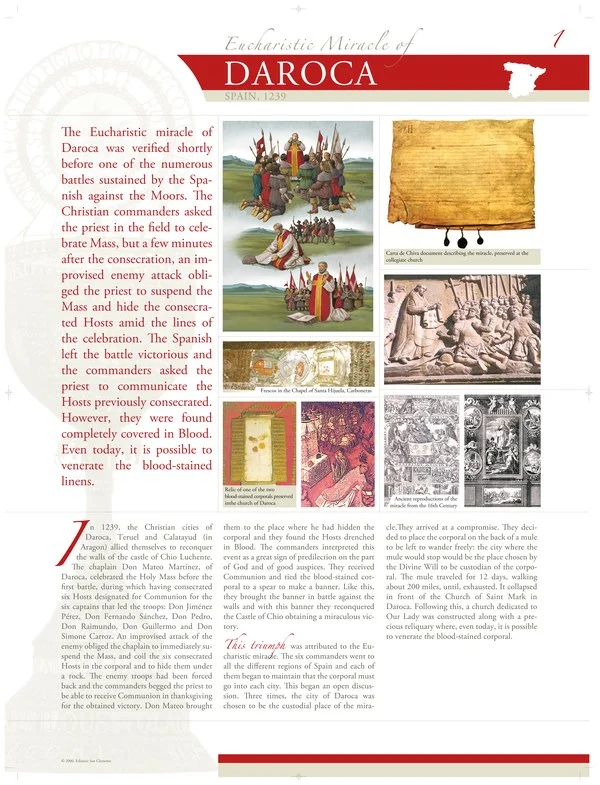
Pannelli Originali della Mostra di San Carlo Acutis (300 DPI)
Inspecione a composição gráfica original em alta resolução (300 DPI, formato 60×80 cm), com o design e tipografia preservados exatamente como idealizados pelo autor.