Highlights
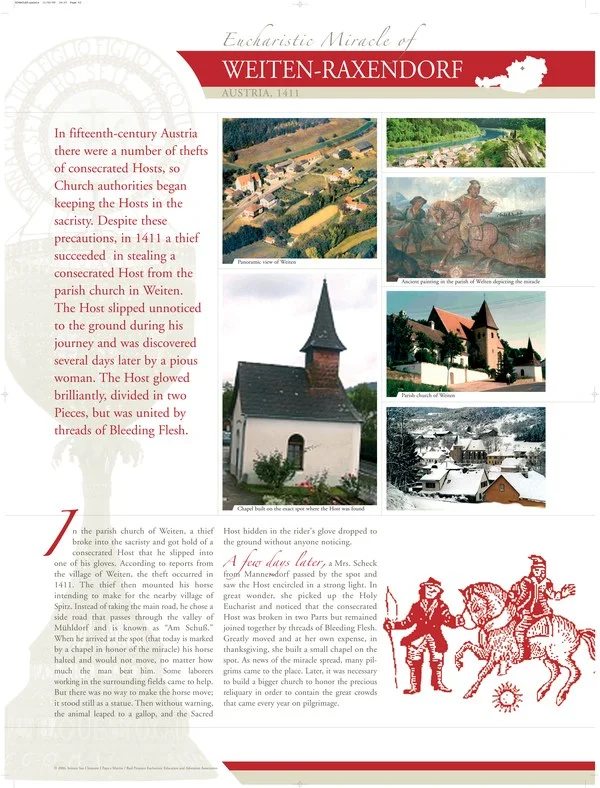
MIRACLES-panels 11/02/08 14:33 Page 52 In fifteenth-century Austria there were a number of thefts of consecrated Hosts, so Church authorities began keeping the Hosts in the sacristy, Despite these precautions, in 1411 a thief succeeded in stealing a consecrated Host from the parish church in Weiten, The Host slipped unnoticed to the ground during his journey and was discovered several days later by a pious woman, The Host glowed brilliantly, divided in two Pieces, but was united by threads of Bleeding Flesh, n the parish church of Weiten, a thief broke into the sacristy and got hold of a consecrated Host that he slipped into one of his gloves. According to reports from the village of Weiten, the theft occurred in 1411. The thief then mounted his horse intending to make for the nearby village of Spitze Instead of taking the main road, he chose a side road that passes through the valley of Mühldorf and is known as "Am Schuß." When he arrived at the spot (that today is marked by a chapel in honor of the miracle) his horse halted and would not move, no matter how much the man beat him.
Some laborers working in the surrounding fields came to help. But there was no way to make the horse move; it stood still as a statue. Then without warning, the animal leaped to a gallop, and the Sacred AUSTRIA, 1411 a Mrs. Scheck fro Manne orf passed by the spot and saw the Host encircled in a strong light.
In great wonder, she picked up the Holy Eucharist and noticed that the consecrated Host was broken in two Parts but remained joined together by threads of Bleeding Flesh. Greatly moved and at her own expense, in thanksgiving, she built a small chapel on the spot. As news of the miracle spread, many pil- grims came to the place.
Later, it was necessary to build a bigger church to honor the precious reliquary in order to contain the great crowds that came every year on pilgrimage.
Relic Gallery & Historical Records
Fotografias em alta definição das sagradas relíquias, basílicas e documentos históricos catalogados por São Carlo Acutis. Clique para ampliar.

Host hidden in the rider's glove dropped to

Panoramic view of Weiten Chapel built on the exact spot where the Host was found the ground without anyone noticing.

Ancient painting in the parish of Welten depicting the miracle

The Parish Church of Saint Stephen in Weiten, Lower Austria (1411)

Parish church of Weiten

A thief stealing the Host which broke into two bleeding fragments and could not be concealed

Historical artwork and preserved documentation of the Eucharistic Miracle of Weiten-Raxendorf (1411)
Original Exhibition Panels by Saint Carlo Acutis (300 DPI)
Inspecione a composição gráfica original em alta resolução (300 DPI, formato 60×80 cm), com o design e tipografia preservados exatamente como idealizados pelo autor.