Highlights
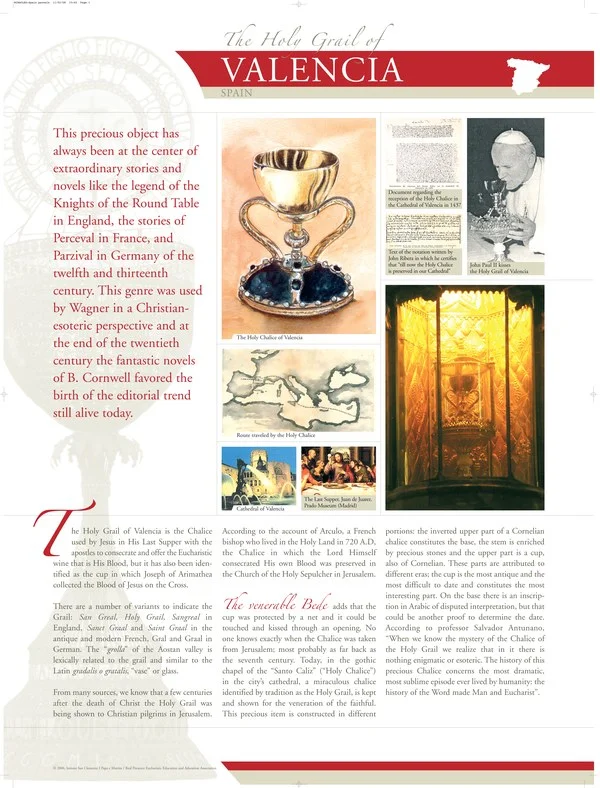
MIRACLES—Spain pannels 11/02/08 15: 45 Page 1 This precious object has always been at the center of extraordinary stories and novels like the legend of the Knights of the Round Table in England, the stories of Perceval in France, and Parzival in Germany of the twelfth and thirteenth century, This genre was used by Wagner in a Christian- esoteric perspective and at the end of the twentieth century the fantastic novels of B, Cornwell favored the birth of the editorial trend still alive today, he Holy Grail of Valencia is the Chalice used by Jesus in His Last Supper with the apostles to consecrate and offer the Eucharistic wine that is His Blood, but it has also been iden- tifled as the cup in which Joseph of Arimathea collected the Blood of Jesus on the Cross. There are a number of variants to indicate the Grail: San Greal, Holy Grail, Sangreal in England, Sanct Graal and Saint Graal in the antique and modern French, Gral and Graal in German. The "grolla" of the Aostan valley is lexically related to the grail and similar to the Latin gradalis o gratalis, "vase" or glass.
From many sources, we know that a few centuries after the death of Christ the Holy Grail was being shown to Christian pilgrims in Jerusalem. the Chalice in which the Lord Himself consecrated His own Blood was preserved in the Church of the Holy Sepulcher in Jerusalem. cup was protected by a net and it could be touched and kissed through an opening.
No one knows exactly when the Chalice was taken from Jerusalem; most probably as far back as the seventh century. Today, in the gothic chapel of the "Santo Caliz" ("Holy Chalice") in the city's cathedral, a miraculous chalice identified by tradition as the Holy Grail, is kept and shown for the veneration of the faithful. This precious item is constructed in different by precious stones and the upper part is a cup, also of Cornelian.
These parts are attributed to different eras; the cup is the most antique and the most difficult to date and constitutes the most interesting part. On the base there is an inscrip- tion in Arabic of disputed interpretation, but that could be another proof to determine the date. According to professor Salvador Antunano, "When we know the mystery of the Chalice of the Holy Grail we realize that in it there is nothing enigmatic or esoteric.
The history of this precious Chalice concerns the most dramatic, most sublime episode ever lived by humanity: the history of the Word made Man and Eucharist". MIRACLES—Spain pannels 11/02/08 15: 45 Page 2 consecrate cerime Cross. iiiiiL MS' 17. COPA b
Relic Gallery & Historical Records
Fotografias em alta definição das sagradas relíquias, basílicas e documentos históricos catalogados por São Carlo Acutis. Clique para ampliar.

Documento de ingreso dcl Santo COIiz en Ia Catedral de Valencia 1437. Document regarding the reception of the Holy Chalice in the Cathedral of Valencia in 1437

John Paul 11 kisses the Holy Grail of Valencia

The Holy Chalice of Valencia

Route traveled by the Holy Chalice Cathedral of Valencia According to the account of Arculo, a French bishop who lived in the Holy Land in 720 AD,

The Holy Chalice of the Last Supper (Santo Cáliz) preserved in the Chapel of the Holy Grail, Valencia Cathedral

The Last Supper. Juan de Juarez. Prado Museum (Madrid)

escrito Juan de Ribera. testificando a Santo Cilia hov valentinae, Text of the notation written by John Ribera in which he certifies that "till now the Holy Chalice is preserved in our Cathedral"

portions: the inverted upper part of a Cornelian chalice constitutes the base, the stem is enriched

1 uCC 1 P C 1 ON ',$. Esquema descriptivo. Medidas.

Precious Monstrance preserved in the cathedral of Valencia

The Gothic Cathedral of Santa María in Valencia, custodian of the Holy Chalice of Christ

Gilded reliquary and sacred relic preserved from the Eucharistic Miracle of Valencia (1392)

Historical artwork and preserved documentation of the Eucharistic Miracle of Valencia (1392)

Historical artwork and preserved documentation of the Eucharistic Miracle of Valencia (1392)

Historical artwork and preserved documentation of the Eucharistic Miracle of Valencia (1392)
Original Exhibition Panels by Saint Carlo Acutis (300 DPI)
Inspecione a composição gráfica original em alta resolução (300 DPI, formato 60×80 cm), com o design e tipografia preservados exatamente como idealizados pelo autor.