Highlights
Listen
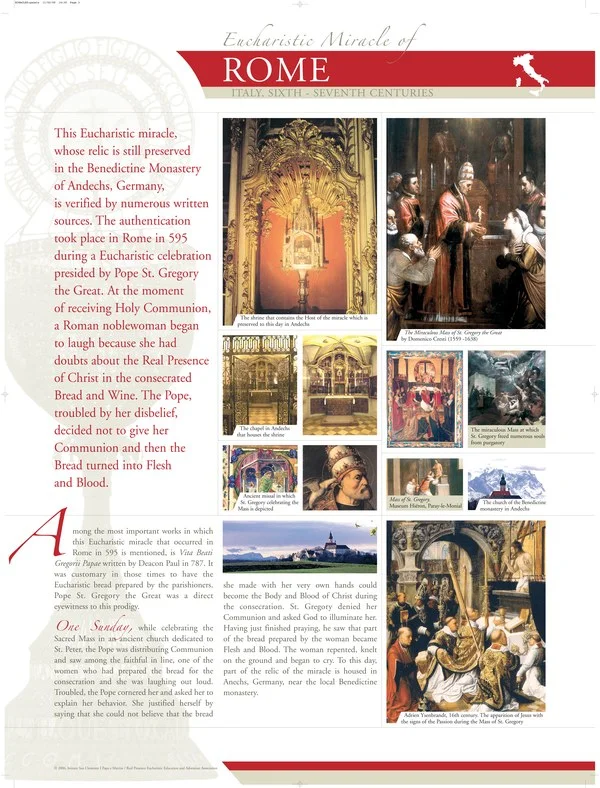
MIRACLES-panels 11/02/08 14:30 Page 3 This Eucharistic miracle, whose relic is still preserved in the Benedictine Monastery of Andechs, Germany, is verified by numerous written sources, The authentication took place in Rome in 595 during a Eucharistic celebration presided by Pope St. Gregory the Great, At the moment of receiving Holy Communion, a Roman noblewoman began to laugh because she had doubts about the Real Presence of Christ in the consecrated Bread and Wine, The Pope, troubled by her disbelief, decided not to give her Communion and then the Bread turned into Flesh and Blood, mong the most important works in which this Eucharistic miracle that occurred in Rome in 595 is mentioned, is Vita Beati Gregorii Papae written by Deacon Paul in 787. It was customary in those times to have the Eucharistic bread prepared by the parishioners.
Pope St. Gregory the Great was a direct eyewitness to this prodigy. while celebrating the Sacred Mass in a ancient church dedicated to St. Peter, the Pope was distributing Communion and saw among the faithful in line, one of the women who had prepared the bread for the consecration and she was laughing out loud.
Troubled, the Pope cornered her and asked her to explain her behavior. She justified herself by saying that she could not believe that the bread ITALY, SIXTH - SEVENTH CENTURIES Communion and asked God to illuminate her. Having just finished praying, he saw that part of the bread prepared by the woman became Flesh and Blood.
The woman repented, knelt on the ground and began to cry. To this day, part of the relic of the miracle is housed in Anechs, Germany, near the local Benedictine monastery. Adrien Ysenbrandt, 16th century. The apparition of Jesus with MIRACLES-panels 11/02/08 14:31 Page 4 ITALY, SIXTH - SEVENTH CENTURIES MIRACLES-panels 11/02/08 14:32 Page 35 It is still possible today to see the miraculous imprint left by the Host which fell on the steps of the altar in the Caetani Chapel of Santa Pudenziana Church in Rome, The imprint on the step was left when the Host fell from the hands of a priest who, while celebrating Mass, began to doubt the Real Presence of Christ in the sacrament of the Eucharist.
anta Pudenziana is one of the oldest churches in Rome. According to a great number of historians, the Roman Senator Pudente gave hospitality to the Apostle Peter in his home, which stood exactly where the church's founda- tion lies. The name of the church is said to derive from the name of the Senator's daughter: Pudenziana.
P and her sister Prassede, although never martyred, became famous because they wiped off the blood of the martyrs after they were executed. The church is adorned by numer- ous Roman mosaics from the early Christian era and was constructed in 145 A.D. on the site where there stood the house of Senator Pudente, according to the wishes of his daughters Prassede and Pudenziana.
On the altar steps of the Caetani ITALY, 1610 Blood left by a Host which fell from the hands of a priest while celebrating the Mass. The man was overtaken by doubts about the Real Presence of Jesus in consecrated Host, and immediately after the consecration, he inadver- tently let the Host fall to the ground, where the imprinted mark is still visible today. marble floor
🔬 Scientific & Forensic Investigation
Rigorous histological, immunological and chromatographic analysis verified authentic human tissue with no chemical preservatives.
Relic Gallery & Historical Records
Fotografias em alta definição das sagradas relíquias, basílicas e documentos históricos catalogados por São Carlo Acutis. Clique para ampliar.

Y The Miraculous Mass of St. Gregory the Great by Domenico Cresti (1559 -1638)

The church of the Benedictine the signs of the Passion during the Mass of St. Gregory

The chapel in Andechs that houses the shrine St. Gregory celebrating the Mass is depicted

from purgatory monastery in Andechs

The shrine that contains the Host of the miracle which is preserved to this day in Andechs

Marble step of the altar of Santa Pudenziana stained with the Blood of the miracle

Mass of St. Gregory. Museum Hiéron, Paray-le-Monial

Basilica of Santa Pudenziana on the Viminal Hill in Rome

she made with her very own hands could become the Body and Blood of Christ during the consecration. St. Gregory denied her

Reliquary containing the blood-stained stone slab of Santa Pudenziana

The miraculous Mass at which St. Gregory freed numerous souls

Ancient 4th-century mosaic in the apse of the Basilica of Santa Pudenziana

Nicolb Circignani called the Pornarancio, The Eucharistic Miracle of St. Gregory the Great. The lunette of the portico in the entrance of the Church of St. Gregory the Great in Heaven, Rome

Icon of St. Gregory Church of St. Gregory the Great in Heaven, Rome

Papal Altar and Bernini's Baldacchino in Saint Peter's Basilica, Vatican

The Chapel of the Blessed Sacrament inside Saint Peter's Basilica

Reliquary preserving the miracle Host of 1595 in the Vatican Treasury

Processional monstrance used during the papal Corpus Christi procession in Rome

Interior of the Church

St. Pudenziana Church, Rome

Detail of the stain of Blood left by the fallen Host Detail of the impression left by the Host that had fallen on the

Steps in the chapel that clearly show the imprint of the stain of Blood left by the fallen Host. Chapel, constructed by the Caetani family, to this day there is the imprint and the stain of

Fresco of Pope Saint Gregory the Great holding the miraculous Flesh before the congregation (595 A.D.)
Original Exhibition Panels by Saint Carlo Acutis (300 DPI)
Inspecione a composição gráfica original em alta resolução (300 DPI, formato 60×80 cm), com o design e tipografia preservados exatamente como idealizados pelo autor.