Highlights
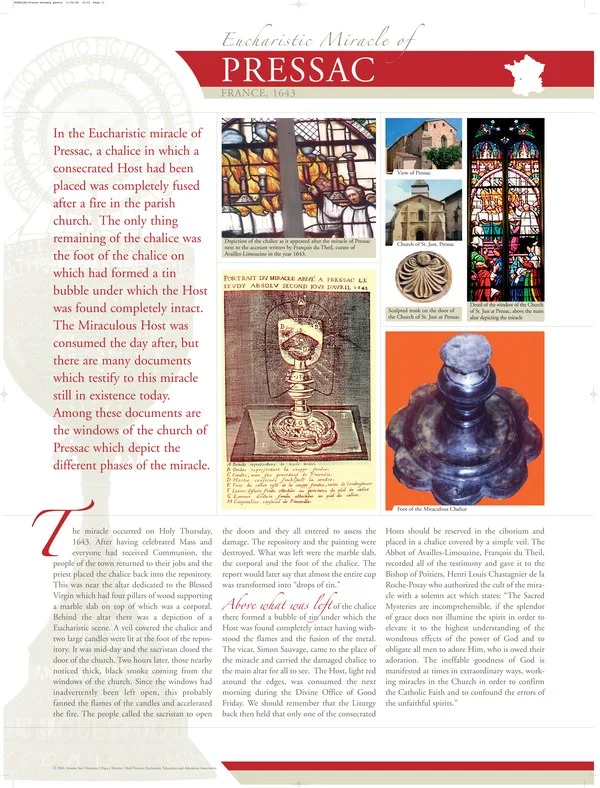
MIRACLES—France Germany panels 11/02/08 10 : 33 Page 11 In the Eucharistic miracle of Pressac, a chalice in which a consecrated Host had been placed was completely fused after a fire in the parish church, The only thing remaining of the chalice was the foot of the chalice on which had formed a tin bubble under which the Host was found completely intact, The Miraculous Host was consumed the day after, but there are many documents which testify to this miracle still in existence today, Among these documents are the windows of the church of Pressac which depict the different phases of the miracle, he miracle occurred on Holy Thursday, 1643. After having celebrated Mass and everyone had received Communion, the people of the town returned to their jobs and the priest placed the chalice back into the repository. This was near the altar dedicated to the Blessed Virgin which had four pillars of wood supporting a marble slab on top of which was a corporal.
Behind the altar there was a depiction of a Eucharistic scene. A veil covered the chalice and two large candles were lit at the foot of the repos- itory. It was mid-day and the sacristan closed the door of the church. Two hours later, those nearby noticed thick, black smoke coming from the windows of the church.
Since the windows had inadvertently been left open, this probably fanned the flames of the candles and accelerated the fire. The people called the sacristan to open FRANCE, 1643 PORTRAIT DV MIRACLE ARIVÉ A PRESSAC LE IEVDY ABSOLV SECOND IOVR IYAVRIL A POG•tCiS s B Ostlbre Ia C Cenclre , a uzc destroyed. What was left were the marble slab, the corporal and the foot of the chalice.
The report would later say that almost the entire cup was transformed into "drops of tin.' of the chalice there formed a bubble of ti under which the Host was found completely intact having with- stood the flames and the fusion of the metal. The vicar, Simon Sauvage, came to the place of the miracle and carried the damaged chalice to the main altar for all to see. The Host, light red around the edges, was consumed the next morning during the Divine Office of Good Friday.
We should remember that the Liturgy back then held that only one of the consecrated Foot of the Miraculous Chalice Lüsil bgnns Hosts should be reserved in the ciborium and placed in a chalice covered by a simple veil. The Abbot of Availles-Limouzine, Frangois du Theil, recorded all of the testimony and gave it to the Bishop of Poitiers, Henri Louis Chastagnier de la Roche-Posay who authorized the cult of the mira- cle with a solemn act which states: "The Sacred Mysteries are incomprehensible, if the splendor of grace does not illumine the spirit in order to elevate it to the highest understanding of the wondrous effects of the power of God and to obligate all men to adore Him, who is owed their adoration. The ineffable goodness of God is manifested at times in extraordinary ways, work- ing miracles in the Church in order to confirm the Catholic Faith and to confound the errors of the unfaithful spirits.
🔬 Scientific & Forensic Investigation
Rigorous histological, immunological and chromatographic analysis verified authentic human tissue with no chemical preservatives.
Relic Gallery & Historical Records
Fotografias em alta definição das sagradas relíquias, basílicas e documentos históricos catalogados por São Carlo Acutis. Clique para ampliar.

Detail of the window of the Church of St. Just at Pressac, above the main altar depicting the miracle

Availles-Limouzine in the year 1643. roceda de 'jrtccttdze ' Joub/feu& IL cendre. D H o site cott era-ce E caj•ce de ld dc F Lanats d's'?.dbtfotsdu ayacæes au du cance dcsqa agachéeg au the doors and they all entered to assess the damage. The repository and the painting were

the Church of St. Just at Pressac

View of Pressac

Church of St. Just, Pressac

Sculpted mask on the door of

Depiction of the chalice as it appeared after the miracle of Pressac next to the account written by Frangois du Theil, curate of
Original Exhibition Panels by Saint Carlo Acutis (300 DPI)
Inspecione a composição gráfica original em alta resolução (300 DPI, formato 60×80 cm), com o design e tipografia preservados exatamente como idealizados pelo autor.