Highlights
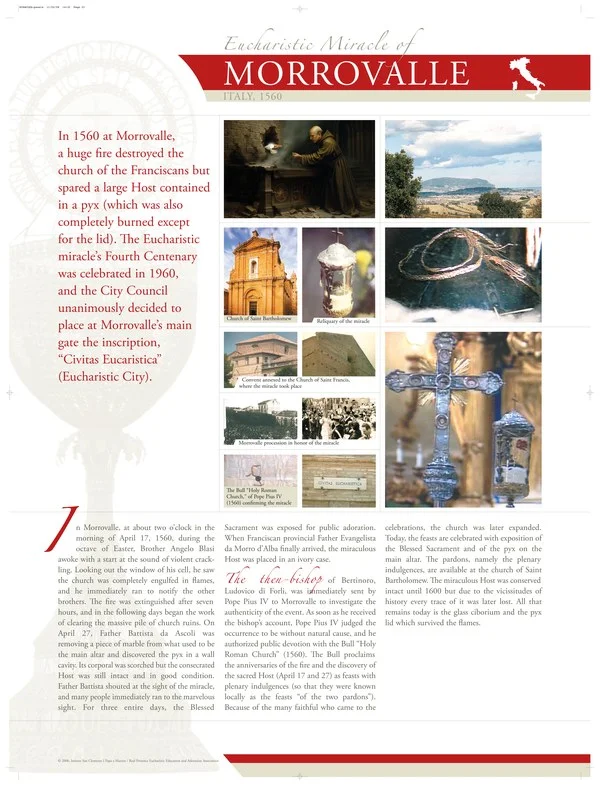
MIRACLES-panels 11/02/08 14:32 Page 23 In 1560 at Morrovalle, a huge fire destroyed the church of the Franciscans but spared a large Host contained in a pyx (which was also completely burned except for the lid), Eucharistic miracle's Fourth Centenary was celebrated in 1960, and the City Council unanimously decided to place at Morrovalle's main gate the inscription, 'Civitas Eucaristica' (Eucharistic City), n Morrovalle, at about two o'clock in the morning of April 17, 1560, during the octave of Easter, Brother Angelo Blasi awoke with a start at the sound of violent crack- ling. Looking out the window of his cell, he saw the church was completely engulfed in flames, and he immediately ran to notify the other brothers. Elhe fire was extinguished after seven hours, and in the following days began the work of clearing the massive pile of church ruins.
On April 27, Father Battista da Ascoli was removing a piece of marble from what used to be the main altar and discovered the pyx in a wall cavity. Its corporal was scorched but the consecrated Host was still intact and in good condition. Father Battista shouted at the sight of the miracle, and many people immediately ran to the marvelous sight.
For three entire days, the Blessed da Morro d'Alba finally arrived, the miraculous Host was placed in an ivory case. of Bertinoro, Ludovico di Forli, was i mediately sent by Pope Pius IV to Morrovalle to investigate the authenticity of the event. As soon as he received the bishop's account, Pope Pius IV judged the occurrence to be without natural cause, and he authorized public devotion with the Bull "Holy Roman Church" (1560).
The Bull proclaims the anniversaries of the fire and the discovery of the sacred Host (April 17 and 27) as feasts with plenary indulgences (so that they were known locally as the feasts "of the two pardons"). Because of the many faithful who came to the the Blessed Sacrament and of the pyx on the main altar. The pardons, namely the plenary indulgences, are available at the church of Saint Bartholomew.
lhe miraculous Host was conserved intact until 1600 but due to the vicissitudes of history every trace of it was later lost. All that remains today is the glass ciborium and the pyx lid which survived the flames.
🔬 Scientific & Forensic Investigation
Rigorous histological, immunological and chromatographic analysis verified authentic human tissue with no chemical preservatives.
Relic Gallery & Historical Records
Fotografias em alta definição das sagradas relíquias, basílicas e documentos históricos catalogados por São Carlo Acutis. Clique para ampliar.

The Franciscan Convent Church of San Bartolomeo in Morrovalle, Marche (1560)

Convent annexed to the Church of Saint Francis, where the miracle took place

Morrovalle procession in honor of the miracle Bull "Holy Roman Church," of Pope Pius IV (1560) confirming the miracle

EUCHARISTICÅ Sacrament was exposed for public adoration. When Franciscan provincial Father Evangelista

Reliquary of the miracle

The devastating fire consuming the entire church and high altar while leaving the Host completely intact in the ashes

Historical artwork and preserved documentation of the Eucharistic Miracle of Morrovalle (1560)

Historical artwork and preserved documentation of the Eucharistic Miracle of Morrovalle (1560)

Historical artwork and preserved documentation of the Eucharistic Miracle of Morrovalle (1560)

celebrations, the church was later expanded. Today, the feasts are celebrated with exposition of

Historical artwork and preserved documentation of the Eucharistic Miracle of Morrovalle (1560)

ITALY, 1560
Original Exhibition Panels by Saint Carlo Acutis (300 DPI)
Inspecione a composição gráfica original em alta resolução (300 DPI, formato 60×80 cm), com o design e tipografia preservados exatamente como idealizados pelo autor.