Highlights
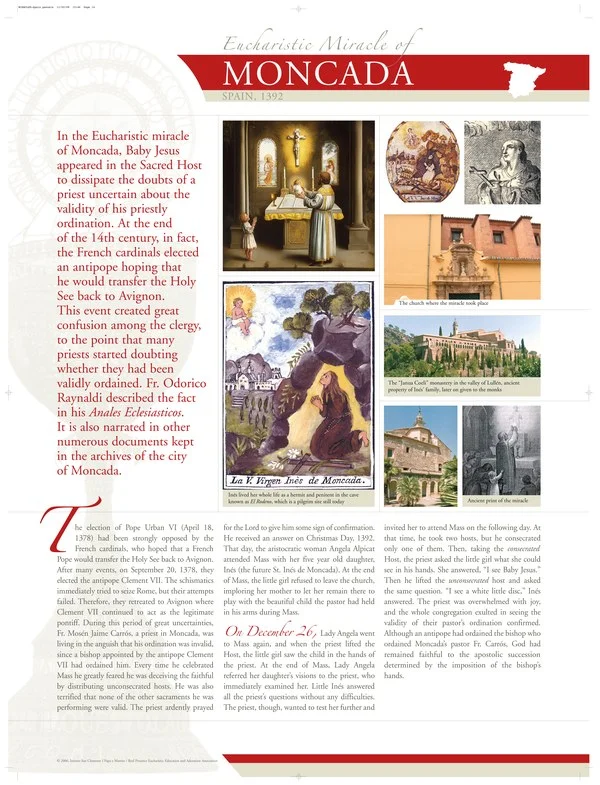
MIRACLES—Spain pannels 11/02/08 15 : 46 Page 14 In the Eucharistic miracle of Moncada, Baby Jesus appeared in the Sacred Host to dissipate the doubts of a priest uncertain about the validity of his priestly ordination, At the end of the 14th century, in fact, the French cardinals elected an antipope hoping that he would transfer the Holy See back to Avignon, This event created great confusion among the clergy, to the point that many priests started doubting whether they had been validly ordained, Fre Odorico Raynaldi described the fact in his Anales Eclesiasticos, It is also narrated in other numerous documents kept in the archives of the city of Moncada, he election of Pope Urban VI (April 18, 1378) had been strongly opposed by the French cardinals, who hoped that a French Pope would transfer the Holy See back to Avignon. After many events, on September 20, 1378, they elected the antipope Clement VII. The schismatics immediately tried to seize Rome, but their attempts failed.
Therefore, they retreated to Avignon where Clement VII continued to act as the legitimate pontiff. During this period of great uncertainties, Fr. Mosén Jaime Carr6s, a priest in Moncada, was living in the anguish that his ordination was invalid, since a bishop appointed by the antipope Clement VII had ordained him.
Every time he celebrated Mass he greatly feared he was deceiving the faithful by distributing unconsecrated hosts. He was also terrified that none of the other sacraments he was performing were valid. The priest ardently prayed SPAIN, 1392 r.iC!lnc i i lill That day, the aristocratic woman Angela Alpicat attended Mass with her five year old daughter, Inés (the future St.
Inés de Moncada). At the end of Mass, the little girl refused to leave the church, imploring her mother to let her remain there to play with the beautiful child the pastor had held in his arms during Mass. Lady Angela went to Mass again, and when the priest lifted the Host, the little girl saw the child in the hands of the priest.
At the end of Mass, Lady Angela referred her daughter's visions to the priest, who immediately examined her. Little Inés answered all the priest's questions without any difficulties. The priest, though, wanted to test her further and 7Ä'iih' t' only one of them.
Then, taking the consecrated Host, the priest asked the little girl what she could see in his hands. She answered, "I see Baby Jesus. Then he lifted the unconsecrated host and asked the same question. "I see a white little disc," Inés answered. The priest was overwhelmed with joy, and the whole congregation exulted in seeing the validity of their pastor's ordination confirmed.
Although an antipope had ordained the bishop who ordained Moncada's pastor Fr. Carr6s, God had remained faithful to the apostolic succession determined by the imposition of the bishop's hands.
🔬 Scientific & Forensic Investigation
Rigorous histological, immunological and chromatographic analysis verified authentic human tissue with no chemical preservatives.
Relic Gallery & Historical Records
Fotografias em alta definição das sagradas relíquias, basílicas e documentos históricos catalogados por São Carlo Acutis. Clique para ampliar.

Historical artwork and preserved documentation of the Eucharistic Miracle of Moncada (1392)

Historical artwork and preserved documentation of the Eucharistic Miracle of Moncada (1392)

The church where the miracle took place

property of Inés' family, later on given to the monks for the Lord to give him some sign of confirmation. invited her to attend Mass on the following day. At He received an answer on Christmas Day, 1392. that time, he took two hosts, but he consecrated

Gilded reliquary and sacred relic preserved from the Eucharistic Miracle of Moncada (1392)

Inés lived her whole life as a hermit and penitent in the cave known as El Rodeno, which is a pilgrim site still today

The "Janua Coeli" monastery in the valley of Lullén, ancient

Ancient print of the miracle
Original Exhibition Panels by Saint Carlo Acutis (300 DPI)
Inspecione a composição gráfica original em alta resolução (300 DPI, formato 60×80 cm), com o design e tipografia preservados exatamente como idealizados pelo autor.