Highlights
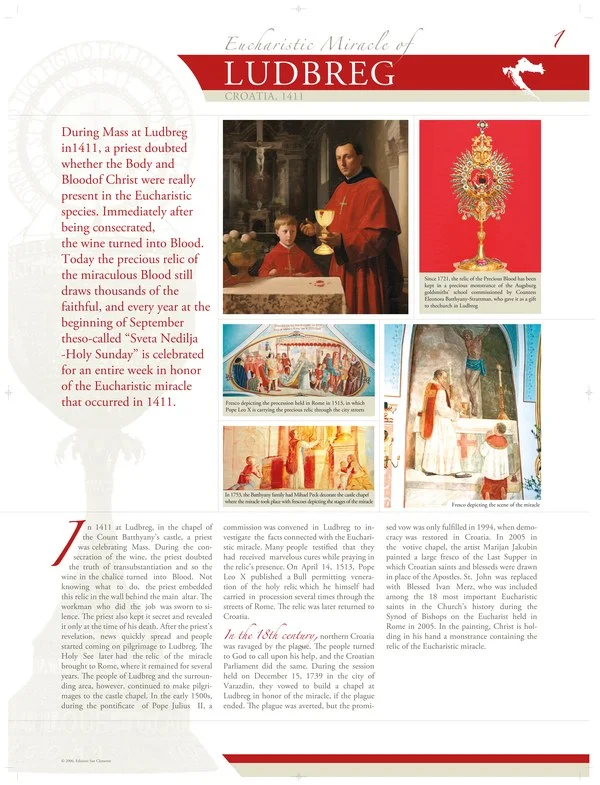
During Mass at Ludbreg in 1411, a priest doubted whether the Body and Bloodof Christ were really present in the Eucharistic species. Immediately after being consecrated, the wine turned into Blood, Today the precious relic of the miraculous Blood still draws thousands of the faithful, and every year at the beginning of September theso-called "Sveta Nedilja -Holy Sunday" is celebrated for an entire week in honor of the Eucharistic miracle that occurred in 1411, n 1411 at Ludbreg, in the chapel of the Count Batthyany's castle, a priest was celebrating Mass. During the con- secration of the wine, the priest doubted the truth of transubstantiation and so the wine in the chalice turned into Blood.
Not knowing what to do, the priest embedded this relic in the wall behind the main altar. Rlhe workman who did the job was sworn to si- lence. lhe priest also kept it secret and revealed it only at the time of his death. After the priest's revelation, news quickly spread and people started coming on pilgrimage to Ludbreg.
Flhe Holy See later had the relic of the miracle brought to Rome, where it remained for several years. The people of Ludbreg and the surroun- ding area, however, continued to make pilgri- mages to the castle chapel. In the early 1500s, during the pontificate of Pope Julius II, a Etoe L/"östöe where the miracle took place with frescoes depicting the stages of the miracle commission was convened in Ludbreg to in- vestigate the facts connected with the Euchari- stic miracle.
Many people testified that they had received marvelous cures while praying in the relic's presence. On April 14, 1513, Pope Leo X published a Bull permitting venera- tion of the holy relic which he himself had carried in procession several times through the streets of Rome. lhe relic was later returned to Croatia.
cedar / northern Croatia was ravaged by the pla e. The people turned to God to call upon his help, and the Croatian Parliament did the same. During the session held on December 15, 1739 in the city of Varazdin, they vowed to build a chapel at Ludbreg in honor of the miracle, if the plague ended.
The plague was averted, but the promi- the votive chapel, the artist Marijan Jakubin painted a large fresco of the Last Supper in which Croatian saints and blesseds were drawn in place of the Apostles. St. John was replaced with Blessed Ivan Merz, who was included among the 18 most important Eucharistic saints in the Church's history during the Synod of Bishops on the Eucharist held in Rome in 2005.
In the painting, Christ is hol- ding in his hand a monstrance containing the relic of the Eucharistic miracle. eccoas moustruce Etoe L/"östöe Stratbuzt/& •goo TAXO uu:gjo SVU'te
🔬 Scientific & Forensic Investigation
Rigorous histological, immunological and chromatographic analysis verified authentic human tissue with no chemical preservatives.
Relic Gallery & Historical Records
Fotografias em alta definição das sagradas relíquias, basílicas e documentos históricos catalogados por São Carlo Acutis. Clique para ampliar.

Since 1721, the relic of the Precious Blood has been kept in a precious monstrance of the Augsburg goldsmiths' school commissioned by Countess Eleonora Batthyany-Strattman, who gave it as a gift to thechurch in Ludbreg

Fresco depicting the procession held in Rome in 1513, in which Pope Leo X is carrying the precious relic through the city streets

In 1753, the Batthyany family had Mihael Peck decorate the castle chapel

Fresco depicting the scene of the miracle sed vow was only fulfilled in 1994, when demo- cracy was restored in Croatia. In 2005 in

Kelikvuom bv.KCVI v'" koju je •vodio u Rimu Leo X, IS13.God.

Castle Chapel of the Holy Cross in Batthyány Castle where the Eucharistic miracle occurred in 1411

The priest concealing the blood-filled ampoule behind the altar wall out of fear in 1411

occurred Batthyany family castle

Shrine of the Miracle of the Precious Blood, Ludbreg

Papal bull of Pope Leo X (1513) officially approving public veneration of the Holy Blood of Ludbreg

Interior of the shrine

The Croatian Parliament (Sabor) vow of 1739 to build a votive chapel in honor of the Holy Blood

Votive chapel of the Croatian Sabor built in fulfillment of the 1739 pledge

Marijan Jakubin, The Last Supper, Shrine of the Miracle of the Precious Blood, Ludbreg

Procession held every year in September, during the week when the miracle called Sveta Nedilja is celebrated

Thousands of faithful gathered for the open-air Eucharistic celebration in Ludbreg

Archbishop and bishops carrying the monstrance of the Precious Blood in procession

Main altar and Eucharistic canopy of the National Sanctuary of the Holy Blood in Ludbreg

Interior of the chapel of the

The chapel of the Batthyany family castle where the miracle
Original Exhibition Panels by Saint Carlo Acutis (300 DPI)
Inspecione a composição gráfica original em alta resolução (300 DPI, formato 60×80 cm), com o design e tipografia preservados exatamente como idealizados pelo autor.