Highlights
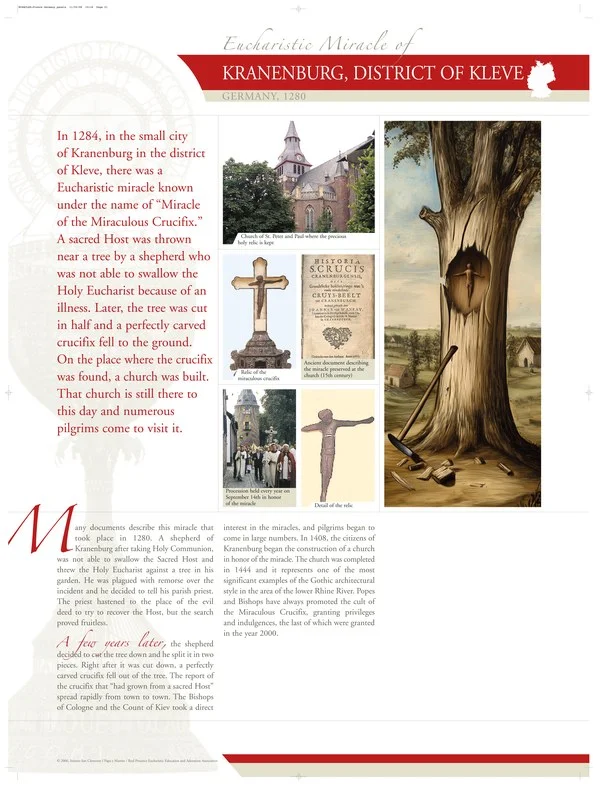
MIRACLES-France Germany panels 11/02/08 10:34 Page 21 In 1284, in the small city of Kranenburg in the district of Kleve, there was a Eucharistic miracle known under the name of "Miracle of the Miraculous Crucifix.' A sacred Host was thrown near a tree by a shepherd who was not able to swallow the Holy Eucharist because of an illness, Later, the tree was cut in half and a perfectly carved crucifix fell to the ground, On the place where the crucifix was found, a church was built, That church is still there to this day and numerous pilgrims come to visit it, any documents describe this miracle that took place in 1280. A shepherd of Kranenburg after taking Holy Communion, was not able to swallow the Sacred Host and threw the Holy Eucharist against a tree in his garden. He was plagued with remorse over the incident and he decided to tell his parish priest.
The priest hastened to the place of the evil deed to try to recover the Host, but the search proved fruitless. the shepherd deci ed toc the tree down and he split it in two pieces. Right after it was cut down, a perfectly carved crucifix fell out of the tree.
The report of the crucifix that "had grown from a sacred Host" spread rapidly from town to town. The Bishops of Cologne and the Count of Kiev took a direct GERMANY, 1280 Grondelicke. bcfchriivingé Van 'c oude mitakeleufe CRüYS-BEELT CRANE-NBL' RCH. deor ' JOANN r..S van WA NR A Y,' T.icentiaet in de Heylige ende " ken der Kerckc S.
Mattini in CRA XENB Kranenburg began the construction of a church in honor of the miracle. The church was completed in 1444 and it represents one of the most significant examples of the Gothic architectural style in the area of the lower Rhine River. Popes and Bishops have always promoted the cult of the Miraculous Crucifix, granting privileges and indulgences, the last of which were granted in the year 2000.
wristie
🔬 Scientific & Forensic Investigation
Rigorous histological, immunological and chromatographic analysis verified authentic human tissue with no chemical preservatives.
Relic Gallery & Historical Records
Fotografias em alta definição das sagradas relíquias, basílicas e documentos históricos catalogados por São Carlo Acutis. Clique para ampliar.

Gcdtuckcvoordcn Authcur. Anno '666. Ancient document describing the miracle preserved at the church (15th century)

Church of St. Peter and Paul where the precious holy relic is kept HISTORrÄ S.CRUCIS CRANENB.URGENSIS,

Relic of the miraculous crucifix

Procession held every year on September 14th in honor of the miracle interest in the miracles, and pilgrims began to come in large numbers. In 1408, the citizens of

Detail of the relic

Gothic high altar of Saints Peter and Paul Church where the Miraculous Cross is preserved

A shepherd spitting the unswallowed Host into a hollow tree, where it transformed into a wooden Crucifix

Historical engraving showing the tree felling in 1308 and the discovery of the sculpted crucifix

The miraculous Crucifix formed from the Sacred Host inside the hollow tree trunk

The Miraculous Cross of Kranenburg ('Das Wundertätige Kreuz') preserved in its golden reliquary

Procession of the Miraculous Cross through the streets of Kranenburg

Pilgrims venerating the Miraculous Cross inside Kranenburg parish church

Interior nave and Gothic vaults of Saints Peter and Paul in Kranenburg

GERMANY, 1280

Panoramic view of Kranenburg and the Lower Rhine countryside
Original Exhibition Panels by Saint Carlo Acutis (300 DPI)
Inspecione a composição gráfica original em alta resolução (300 DPI, formato 60×80 cm), com o design e tipografia preservados exatamente como idealizados pelo autor.