Highlights
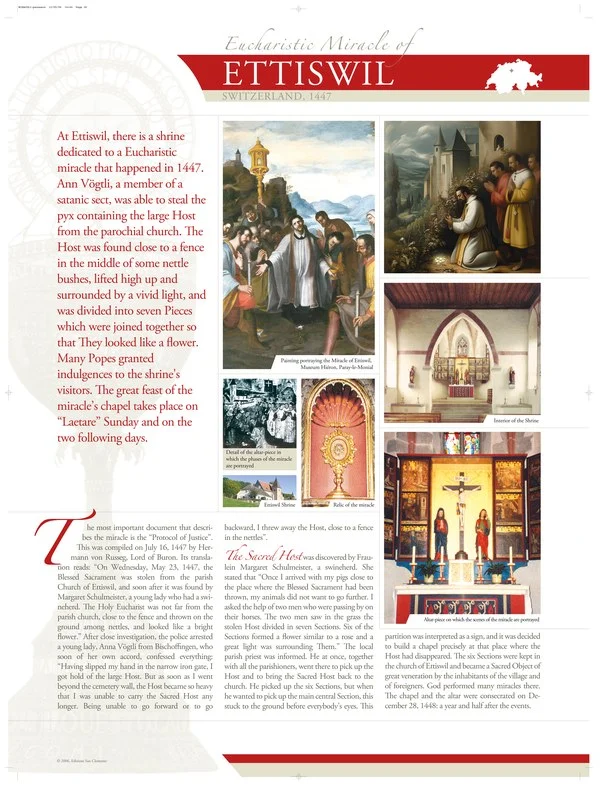
MIRACOLI—panneaux 12/05/06 14 : 40 Page 36 At Ettiswil, there is a shrine dedicated to a Eucharistic miracle that happened in 1447. Ann Vögtli, a member of a satanic sect, was able to steal the pyx containing the large Host from the parochial church, The Host was found close to a fence in the middle of some nettle bushes, lifted high up and surrounded by a vivid light, and was divided into seven Pieces which were joined together so that They looked like a flower. Many Popes granted indulgences to the shrine's visitors, The great feast of the miracle's chapel takes place on "Laetare" Sunday and on the two following days.
he most important document that descri- bes the miracle is the "Protocol of Justice". This was compiled on July 16, 1447 by Her- mann von Russeg, Lord of Buron. Its transla- tion reads: "On Wednesday, May 23, 1447, the Blessed Sacrament was stolen from the parish Church of Ettiswil, and soon after it was found by Margaret Schulmeister, a young lady who had a swi- neherd.
Holy Eucharist was not far from the parish church, close to the fence and thrown on the ground among nettles, and looked like a bright flower." After close investigation, the police arrested a young lady, Anna Vögtli from Bischoffngen, who soon of her own accord, confessed everything: "Having slipped my hand in the narrow iron gate, I got hold of the large Host. But as soon as I went beyond the cemetery wall, the Host became so heavy that I was unable to carry the Sacred Host any longer. Being unable to go forward or to go 1447 /MOstwas discovered by Frau- lein Margaret Schulmeister, a swineherd.
She stated that "Once I arrived with my pigs close to the place where the Blessed Sacrament had been thrown, my animals did not want to go further. I asked the help of two men who were passing by on their horses. The two men saw in the grass the stolen Host divided in seven Sections.
Six of the Sections formed a flower similar to a rose and a great light was surrounding Them." Elhe local parish priest was informed. He at once, together with all the parishioners, went there to pick up the Host and to bring the Sacred Host back to the church. He picked up the six Sections, but when he wanted to pick up the main central Section, this stuck to the ground before everybody's eyes.
This partition was interpreted as a sign, and it was decided to build a chapel precisely at that place where the Host had disappeared. The six Sections were kept in great veneration by the inhabitants of the village and of foreigners. God performed many miracles there.
The chapel and the altar were consecrated on De- cember 28, 1448: a year and half after the events. wristie
🔬 Scientific & Forensic Investigation
Rigorous histological, immunological and chromatographic analysis verified authentic human tissue with no chemical preservatives.
Relic Gallery & Historical Records
Fotografias em alta definição das sagradas relíquias, basílicas e documentos históricos catalogados por São Carlo Acutis. Clique para ampliar.

Painting portraying the Miracle of Ettiswil, Detail of the altar-piece in

Interior of the Shrine

Museum Hiéron, Paray-le-Monial

which the phases of the miracle are portrayed Ettiswil Shrine Relic of the miracle backward, I threw away the Host, close to a fence in the nettles".

the church of Ettiswil and became a Sacred Object of

The young shepherdess Margaret Schulmeister discovering the glowing Host divided into seven petals

The stolen consecrated Host radiating bright light in the nettle bush in Ettiswil

SWITZERLAND, 1447

The six outer petals of the Host lifting into the air when touched, while the center remained immovable

The Bishop of Constance solemnly placing the sacred Host into a golden monstrance

Construction of the Chapel of the Holy Sacrament on the site of the miracle in Ettiswil

Gilded Baroque monstrance holding the sacred relic of the Eucharistic Miracle of Ettiswil

Papal bull of Pope Nicholas V (1447) granting indulgences to pilgrims visiting Ettiswil

Exterior facade of the Chapel of the Holy Sacrament in Ettiswil, Canton of Lucerne
Original Exhibition Panels by Saint Carlo Acutis (300 DPI)
Inspecione a composição gráfica original em alta resolução (300 DPI, formato 60×80 cm), com o design e tipografia preservados exatamente como idealizados pelo autor.