Highlights
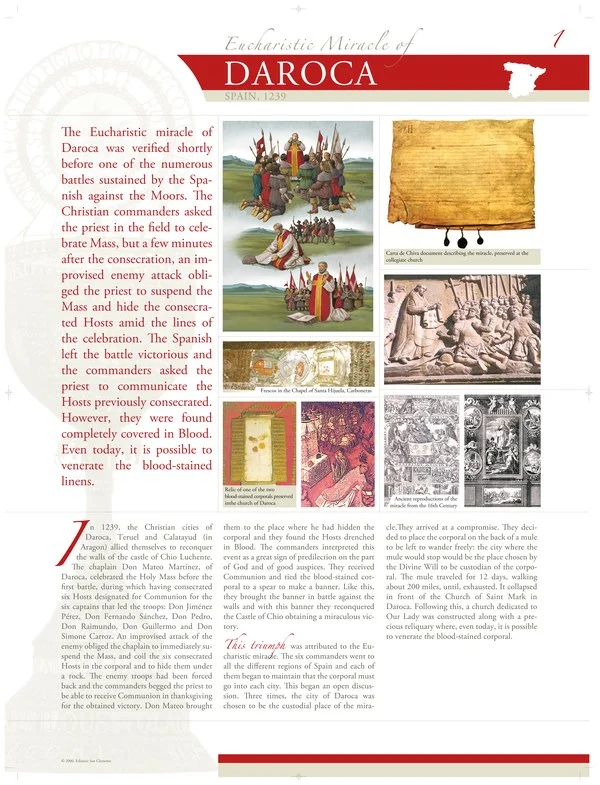
The Eucharistic miracle of Daroca was verified shortly before one of the numerous battles sustained by the Spa- nish against the Moors, lhe Christian commanders asked the priest in the field to cele- brate Mass, but a few minutes after the consecration, an im- provised enemy attack obli- ged the priest to suspend the Mass and hide the consecra- ted Hosts amid the lines of the celebration, The Spanish left the battle victorious and the commanders asked the priest to communicate the Hosts previously consecrated, However, they were found completely covered in Blood, Even today, it is possible to venerate the blood-stained linens. n 1239, the Christian cities of Daroca, Teruel and Calatayud (in Aragon) allied themselves to reconquer the walls of the castle of Chio Luchente. The chaplain Don Mateo Martinez, of Daroca, celebrated the Holy Mass before the first battle, during which having consecrated six Hosts designated for Communion for the six captains that led the troops: Don Jiménez Pérez, Don Fernando Sånchez, Don Pedro, Don Raimundo, Don Guillermo and Don enemy obliged the chaplain to immediately su- spend the Mass, and coil the six consecrated Hosts in the corporal and to hide them under a rock.
The enemy troops had been forced back and the commanders begged the priest to be able to receive Communion in thanksgiving for the obtained victory. Don Mateo brought Etoe L/"östöe SPAIN, 1239 Frescos in the Chapel of Santa Hijuela, Carboneras : .14 f' Relic of one of the two blood-stained corporals preserved inthe church of Daroca them to the place where he had hidden the corporal and they found the Hosts drenched in Blood. The commanders interpreted this event as a great sign of predilection on the part of God and of good auspices.
They received Communion and tied the blood-stained cor- poral to a spear to make a banner. Like this, they brought the banner in battle against the walls and with this banner they reconquered the Castle of Chio obtaining a miraculous vic- tory. was attributed to the Eu- charistic mira e.
six commanders went to all the different regions of Spain and each of them began to maintain that the corporal must go into each city. This began an open discus- sion. Three times, the city of Daroca was chosen to be the custodial place of the mira- Carta de Chiva document describing the miracle, preserved at the collegiate church LOS SANCTISSIMOS DELA V DAD DE DAPOCCA ere.- Ancient reproductions of the JT miracle from the 16th Century cle.They arrived at a compromise.
They deci- ded to place the corporal on the back of a mule to be left to wander freely: the city where the mule would stop would be the place chosen by the Divine Will to be custodian of the corpo- ralo The mule traveled for 12 days, walking about 200 miles, until, exhausted. It collapsed in front of the Church of Saint Mark in Daroca. Following this, a church dedicated to Our Lady was constructed along with a pre- cious reliquary where, even today, it is possible to venerate the blood-stained corporal.
/Ztros6 eze Panoramic view of the church in Daroca Chapel of Los Corporales Flhe Holy Hijuela (Pall) is one of the corporals of the miracle and is preserved at Carboneras Etoe L/"östöe SPAIN, 1239 Ancient pictures depicting the miracle Chapel where the Santa Hijuela Main altar of the (Pall) is preserved, Carboneras church of Daroca Procession held every year in honor of the miracle of Daroca Santa Maria Basilica, Daroca Interior of the church Wall paintings in the Chapel of Los Corporales describing the miracle
Relic Gallery & Historical Records
Fotografias em alta definição das sagradas relíquias, basílicas e documentos históricos catalogados por São Carlo Acutis. Clique para ampliar.

Frescos in the Chapel of Santa Hijuela, Carboneras de Guadazaón

Relic of one of the two blood-stained corporals preserved in the Collegiate Church of Daroca

Ancient 16th-century engraving illustrating the miraculous victory of the Christian commanders under the Eucharistic banner

Historical 'Carta de Chiva' document (1340) chronicling the Eucharistic Miracle of the Holy Corporals

Embossed silver altarpiece depicting 'Los Santíssimos Corporales de la Ciudad de Daroca'

Ancient illumination showing the wandering mule carrying the Holy Corporals towards Daroca

Chaplain Don Mateo Martínez finding the six consecrated Hosts drenched in living Blood under the rock

Gothic processional reliquary of the Holy Corporals (Los Corporales de Daroca)

Main Baroque altar of the Basilica of Santa María in Daroca with the tabernacle of the miracle

The Chapel of Los Corporales inside the Basilica of Santa María in Daroca

Ancient painting depicting the battle of Chio Luchente and the reconquest under the miraculous sign

Wall frescoes in the Chapel of Los Corporales narrating the miraculous translation of the Sacred Relics

Monumental gothic tower and exterior facade of the Basilica of Santa María, Daroca

Panoramic view of the historical medieval city and fortress walls of Daroca

Chapel of the Santa Hijuela in Carboneras de Guadazaón where the second miraculous linen is preserved

Interior nave of the Parish Church of Carboneras de Guadazaón

Solemn annual Corpus Christi procession with the Holy Corporals through the streets of Daroca

Fresco scene 1: Chaplain Don Mateo celebrating Mass before the battle against the Moors

Fresco scene 2: The sudden enemy attack forcing the priest to wrap the consecrated Hosts in the corporal

Fresco scene 3: The priest hiding the sacred corporal under a rock during the combat

Fresco scene 4: The commanders discovering the six Hosts bleeding upon the corporal

Fresco scene 5: The blood-stained corporal tied to a spear and carried as a victorious standard

Fresco scene 6: Dispute among the cities of Daroca, Teruel and Calatayud over the custody of the relic

Fresco scene 7: The mule bearing the Holy Corporal wandering 200 miles across Aragon

Fresco scene 8: The mule collapsing in front of Saint Mark's Church in Daroca

Panoramic view of the city of Daroca and the collegiate church of Santa María

Reliquary bust and commemorative statue of Chaplain Don Mateo Martínez

The Holy Hijuela (Pall) of Carboneras de Guadazaón, one of the two miraculous blood-stained linens of 1239
Original Exhibition Panels by Saint Carlo Acutis (300 DPI)
Inspecione a composição gráfica original em alta resolução (300 DPI, formato 60×80 cm), com o design e tipografia preservados exatamente como idealizados pelo autor.