Highlights
Listen
In 1330, at Cascia, a gravely ill peasant called the priest to re- ceive Communion. Tie priest, partly through carelessness and partly through apathy, in- stead of taking with himself the ciborium to carry the Eu- charist to the house of sick man, took a Host and placed it irreverently in a prayer book. When he reached the peasant the priest opened the book and with astonishment saw that the Host was transformed marked with blood, Eucharistic Miracle, which happened near Siena in 1330.
A priest was asked to bring Communion to a sick peasant. The priest took a consecrated Host and placed it ir- reverently in the pages of his breviary and went to the peasant. When he arrived at the house of the sick man, after hearing his confession, he opened the book to take out the Host which he had placed there.
To his great surprise he found that the Host was stained with living blood, so much as to mark both pages between which it had been placed. The priest, confused and peni- tent, went immediately to Siena to the Augusti- nian Priory to ask the counsel of Fr. Simone Fidati of Cascia, known by all to be a holy man.
Fr. Fidati, having heard the story, granted pardon to the priest and asked to keep the two Etoe L/"östöe act W r ÆiÆ07Tofthe relic of the Eucharis 'c mir c of Cascia in 1687, a text was also reported of a very ancient code of the priory of St. Augustine in which are descri- bed numerous pieces of information regarding the miracle.
Beyond this information, the epi- sode is also mentioned in the Communal Statu- tes of Cascia of 1387 where is was ordered that every year on the Feast of Corpus Christi, the authorities, the counsels, and the people of Cascia, should meet in the Church of St. Augu- Stine and follow the priest who should carry the venerable relic of the Most Holy Body of Christ in procession through the city. In 1930, on the occasion of the sixth centenary of the event, a Eucharistic Congress was celebrated at Cascia
🔬 Scientific & Forensic Investigation
Rigorous histological, immunological and chromatographic analysis verified authentic human tissue with no chemical preservatives.
Relic Gallery & Historical Records
Fotografias em alta definição das sagradas relíquias, basílicas e documentos históricos catalogados por São Carlo Acutis. Clique para ampliar.

ITALY, 1330 into a clot of blood and the pages of the book were

in the left-hand page for the entire diocese of Norcia; a precious and artistic monstrance was consecrated, and the entire historical documentation of the miracle was published.

right-hand page

contained the relic of the miracle pages marked by blood. Many of the Popes pro-

A man's face can clearly be seen t Cascia, in the basilica dedicated to

Tabernacle of the Eucharistic miracle

St. Rita, is also preserved the relic of the

Enlarged reproduction of the face which appeared

Enlarged reproduction of the face which appeared in the

Relic of the Eucharistic miracle

Urn containing the body of by the sculptor Manzu moted veneration conceding indulgences.

Chapel where the relic is kept in the Lowed Basilica

The Basilica of Saint Rita in Cascia, Umbria, sanctuary preserving the Eucharistic Miracle of Siena-Cascia (1330)

The careless priest placing the consecrated Host inside his Breviary, where it liquified into living Blood staining both pages

Historical artwork and preserved documentation of the Eucharistic Miracle of Cascia (1330)

Historical artwork and preserved documentation of the Eucharistic Miracle of Cascia (1330)
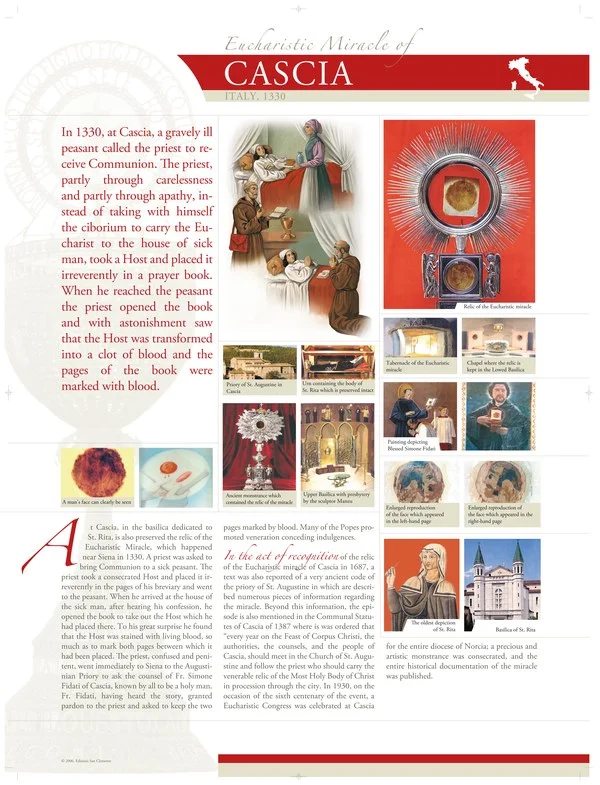
Original Exhibition Panels by Saint Carlo Acutis (300 DPI)
Inspecione a composição gráfica original em alta resolução (300 DPI, formato 60×80 cm), com o design e tipografia preservados exatamente como idealizados pelo autor.