Highlights
Listen
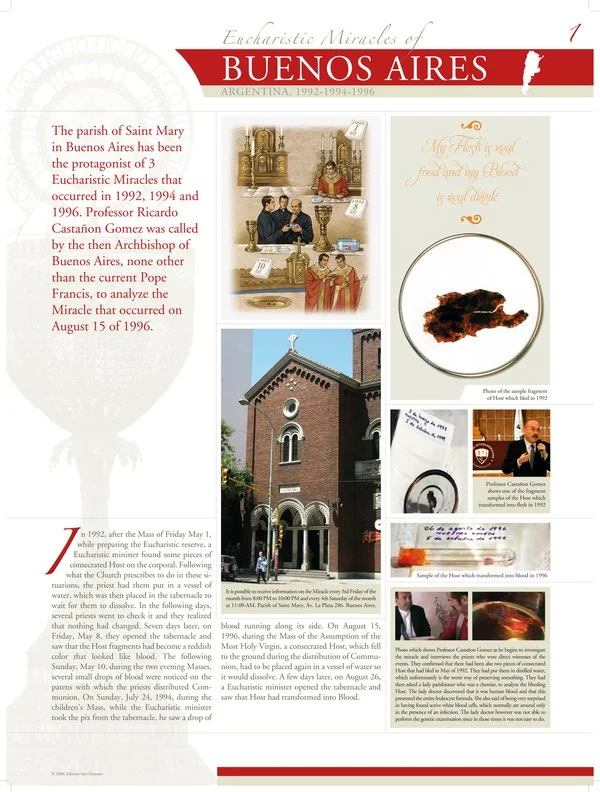
The parish of Saint Mary in Buenos Aires has been the protagonist of 3 Eucharistic Miracles that occurred in 1992, 1994 and 1996, Professor Ricardo Castañón Gomez was called by the then Archbishop of Buenos Aires, none other than the current Pope Francis, to analyze the Miracle that occurred on August 15 of 1996, n 1992, after the Mass of Friday May 1, while preparing the Eucharistic reserve, a Eucharistic minister found some pieces of consecrated Host on the corporal. Following what the Church prescribes to do in these si- tuations, the priest had them put in a vessel of water, which was then placed in the tabernacle to wait for them to dissolve. In the following days, several priests went to check it and they realized that nothing had changed.
Seven days later, on Friday, May 8, they opened the tabernacle and saw that the Host fragments had become a reddish color that looked like blood. The following Sunday, May 10, during the two evening Masses, several small drops of blood were noticed on the patens with which the priests distributed Com- munion. On Sunday, July 24, 1994, during the children's Mass, while the Eucharistic minister took the pyx from the tabernacle, he saw a drop of 1992 1992 1992 It is possible to receive information on the Miracle every 3rd Friday of the month from 8:00 PM to 10:00 PM and every 4th Saturday of the month at 11:00 AM.
Parish of Saint Mary, Av. La Plata 286. Buenos Aires. blood running along its side. On August 15, 1996, during the Mass of the Assumption of the Most Holy Virgin, a consecrated Host, which fell to the ground during the distribution of Commu- nion, had to be placed again in a vessel of water so it would dissolve.
A few days later, on August 26, a Eucharistic minister opened the tabernacle and saw that Host had transformed into Blood. Photo of the sample fragment of Host which bled in 1992 Professor Castañón Gomez shows one of the fragment samples of the Host which transformed into flesh in 1992 Sample of the Host which transformed into blood in 1996 Photo which shows Professor Castañón Gomez as he begins to investigate the miracle and interviews the priests who were direct witnesses of the events. They confirmed that there had been also two pieces of consecrated Host that had bled in May of 1992.
They had put them in distilled water, which unfortunately is the worst way of preserving something. They had then asked a lady parishioner who was a chemist, to analyze the bleeding Host. The lady doctor discovered that it was human blood and that this presented the entire leukocyte formula.
She also said of being very surprised in having found active white blood cells, which normally are around only in the presence of an infection. The lady doctor however was not able to perform the genetic examination since in those times it was not easy to do. This is the account given by an Australian lawyer, Ron Tesorie- ro, who was central to the scienti- fic investigation on the 1996 mi- racle, requested by Archbishop Jorge Bergoglio of Buenos Aires, "On 18 August 1996 after Mass at the Santa Maria Church, a Communion host was found abandoned, The priest put the host in a bowl of water and placed it in the tabernacle until it dissolved, Within days a blo- od-like substance issued from the host, It grew in quantity and transformed over the next 10 days.
Forensic pathology and DNA testing conducted over 20 years has found the substance to be human heart from a living, traumatically injured human, The Science leads to answers that Jesus is truly present in the Communion host and that He is the author of life," was on 5 October 1999, that I went to Buenos Aires to com- mence my investigation upon the invitation of Dr. Ricardo Castañón. We interviewed the priest, Padre Alejandro Pezet and other witnesses and took sam- ples.
I documented on film the essential parts of my entire investigation. My approach was to prepare the case as a lawyer who would go before a judge. On 21 October 1999, we presented a sample for DNA te- sting to Forensic Analytical Genetics laboratory in San Francisco.
On 1 May 2000, they reported to me that whilst there was the presence of human DNA, no human genetic code could be obtained. This was unusual. Different scientists had different opinions. Who was right? I proceeded to study forensic patholo- gy and cell biology.
For more than one year I resear- 1996 1994 1996 Lawyer, Ron Tesoriero speaks of Dr. Zugibe's findings of "host to human heart" at Sydney University on 14 July 2022. ched hundreds of histology images and eventually found forensic pathology and cell biology.
For more than one year I researched hundreds of histology images and eventually found one that resembled the Buenos Aires case. It was inflamed human heart tissue due to a compromised blood supply. I realized that when the heart suffers trauma, it looks very different from standard textbook images of normal heart tissue.
The scientists that I had engaged thus far were not experts in heart trauma. The next step was to find a world expert who was not only a forensic pathologist, but also a cardiologist. I found him in New York: Dr. Frederick Zugibe. On 20 April 2004, a leading Au- stralian investigative journalist, Mike Willesee, ac- companied me to New York to present Dr.
Zugibe with my case samples. Dr. Zugibe had been told nothing of the history of the sample or my research. In On 26 August 1996, when the tabernacle was opened it was noticed that a red substance was coming from the host Padre Alejandro Pezet, found an abandoned Communion Host.
ples or my research. In our presence, as I filmed, he microscopically examined the samples. The only true statements made by Dr. Zugibe are contained in what I recorded and documented at that original meeting. They have since become historic: "I am an expert on the heart.
The heart is my business. This is flesh. This flesh is heart muscle tissue, myocar- dium, from the left ventricle wall not far from a valvular area. It is the muscle that gives the heart it's beat and the body it's life. This heart muscle is inflamed.
It has lost its striations and is infiltrated with white blood cells. White blood cells are not nonnallyfound in heart tissue. These cells are produced by the body and they escape from blood and infiltrate the tissue to address trauma or injury. ARGENTINA, 1992-1994-1996 Dr.
Zugibe continued: "The presence of those white blood cells in the tissue tell me two things: Firstly, This heart has suffered traumatic injury, There has been a compromising of the blood supply to the heart, This is not unlike what I have seen when someone has been beaten severely over the chest in the region of the heart, Secondly, This heart was alive, This heart is from a living person not a dead person, I am looking at a snapshot of a living heart, I can date the injury, I can date when the compromising of the blood supply occurred. It happe- ned 3 days before the snapshot in time captured in the microscopic slide,' asked a theologian what this could pos- sibly mean in the context of Jesus. He said that Church teaches that the Eucharist is a memorial of the passion, death and resur- rection of Jesus.
When we receive Communion, we are receiving Jesus at the moment of his Resurrection, 3 days after His Passion. What astonished Dr. Zugibe was that the white blood cells and the heart tissue were in such a good state of preservation despite having been kept in distilled water for 3 years: "The good state of preservation is what might have been expected if they had been placed in a presemative like fonnalin.
It would be impossible for the white blood cells to be present in the sample if the sample had been kept in water. On 26 March 2005, Dr. Zugibe sent me his formal Aorta Ri ht Atrium Right Ventricle Pulmonar Arter Pulmonary Vein Left Atriu m Left Ventricle uscle oftheM ocardium On 20 April 2004, Dr.
Zugibe examines the sample and identifies traumatised human heart. On 28 February 2008, Foren- sic Pathologist Dr. Lawrence of San Francisco said that his initial identification was wrong. He now agreed enti- rely with Dr. Zugibe's asses- sment. It was traumatised heart tissue I sought the opinion of Profes- sor Linoli in Italy who worked on the Lanciano case.
I showed him my photo of the microsco- pic slide content. He was not sure but said it could be heart tissue. o[lklljl Dr. Zugibe's report on 17 March report on the findings. In part it reads: "The tissues of the heart had undergone degenerative changes of the myocardium possibly due to an ob- struction of a coronmy artery that supplies nutrients and oxygen to an area of heart muscle.
This obstruction may be the result of... a severe blow to the chest over the heart. Mike Willesee summed up the case this way: "When a Communion host, which is bread, bleeds and becomes living human heart, it is more than just a WOW moment. It is a traumatic day for Science.
Why traumatic? Because for the first time ever life has come into existence from inert non-living matter. What has been revealed in my ongoing work is unprecedented. It provides, for the first time ever, a scientific basis for the Catholic Church's belief in: Dr.
Zugibe shows the position from where the heart muscle tissue had come. 1. God as the sole recorded creator of human life. 2. Jesus as truly alive, resurrected and present in the Communion host. 3. Jesus giving us his heart in the Eucharist. Ron Tesoriero has published his work in a new book, My Human Heart: Where Science and Faith Collide and in documentaries available at: www.reasontobelieve.com.au
🔬 Scientific & Forensic Investigation
Rigorous histological, immunological and chromatographic analysis verified authentic human tissue with no chemical preservatives.
Relic Gallery & Historical Records
Fotografias em alta definição das sagradas relíquias, basílicas e documentos históricos catalogados por São Carlo Acutis. Clique para ampliar.

Photo of the sample fragment of the Host that bled in May 1992

Sample of the Host that transformed into blood and flesh in 1996

Parish Church of Saint Mary in Buenos Aires (Av. La Plata 286), sanctuary of the Eucharistic Miracles of 1992, 1994 and 1996

Histological section showing active human white blood cells (leukocytes) inside the inflamed myocardial tissue

Professor Ricardo Castañón Gómez shows one of the fragment samples of the Host that transformed in 1992

Professor Castañón Gómez beginning the scientific investigation and interviewing the eyewitness priests at Saint Mary Parish

Gold circular reliquary preserving the consecrated Host that transformed into blood and flesh on green background

ARGENTINA, 1992-1994-1996

Lawyer Ron Tesoriero speaking on Dr. Zugibe's findings of 'host to human heart' at the University of Sydney (2022)

ARGENTINA, 1992-1994-1996

Dr. Frederic Zugibe (Columbia University) conducting blinded forensic analysis of the Buenos Aires myocardial sample

Historical artwork and preserved documentation of the Eucharistic Miracle of Buenos Aires (1992, 1994, 1996)

our presence, as I filmed, he microscopically exami- ned the been told nothing of the history of the sam-

Gilded reliquary and sacred relic preserved from the Eucharistic Miracle of Buenos Aires (1992, 1994, 1996)

On 26 August 1996, a red blood-like substance issuing from the consecrated Host in the tabernacle

Father Alejandro Pezet, the parish priest who found the abandoned Host at Saint Mary Church in 1996

Anatomical diagram of the human heart showing the left ventricle and myocardium tissue

Professor Odoardo Linoli in Italy (who investigated the Lanciano miracle) examining the photographic prints of the microscopic slide

On 20 April 2004, Dr. Frederic Zugibe examining the cardiac sample under microscope in New York

Microscopic histological slide showing inflamed human myocardium tissue (heart muscle) with active white blood cells

Archbishop Jorge Mario Bergoglio (Pope Francis) receiving Dr. Zugibe's formal forensic report on 17 March 2006

Or watch the documentary on The Official Investi- gation, here:

Dr. Zugibe demonstrating the left ventricle wall position from where the heart muscle tissue originated

Dr. John Walker of Sydney University had a different opinion. He

Forensic Pathologist Dr. Robert Lawrence of San Francisco who confirmed the histological findings

On 9 March 2000, I authorized the sample to be examined by the no-

table Forensic Pathologist Dr. Robert Lawrence in San Francisco who identified it as epidermis (skin) infiltrated with white blood cells.

I subsequently delivered the sample to Dr. Peter Ellis from Sydney University and then to Dr. Tom Loy from Queen sland University for examination. Both confirmed the assessment of Dr. Lawrence. thought it looked more like muscle than skin.
Original Exhibition Panels by Saint Carlo Acutis (300 DPI)
Inspecione a composição gráfica original em alta resolução (300 DPI, formato 60×80 cm), com o design e tipografia preservados exatamente como idealizados pelo autor.