Highlights
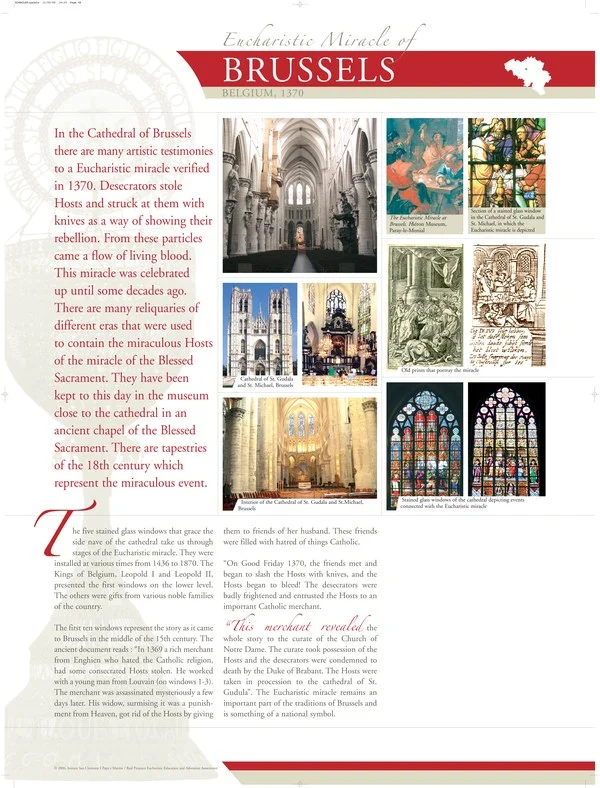
MIRACLES-panels 11/02/08 14:33 Page 46 In the Cathedral of Brussels there are many artistic testimonies to a Eucharistic miracle verified in 1370, Desecrators stole Hosts and struck at them with knives as a way of showing their rebellion, From these particles came a flow of living blood, This miracle was celebrated up until some decades ago, There are many reliquaries of different eras that were used to contain the miraculous Hosts of the miracle of the Blessed Sacrament, They have been kept to this day in the museum close to the cathedral in an ancient chapel of the Blessed Sacrament, There are tapestries of the 18th century which represent the miraculous event, he five stained glass windows that grace the side nave of the cathedral take us through stages of the Eucharistic miracle. They were installed at various times from 1436 to 1870. The Kings of Belgium, Leopold I and Leopold II, presented the first windows on the lower level.
The others were gifts from various noble families of the country. The first ten windows represent the story as it came to Brussels in the middle of the 15th century. The ancient document reads : "In 1369 a rich merchant from Enghien who hated the Catholic religion, had some consecrated Hosts stolen.
He worked with a young man from Louvain (on windows 1-3). The merchant was assassinated mysteriously a few days later. His widow, surmising it was a punish- ment from Heaven, got rid of the Hosts by giving BELGIUM, 1370 "On Good Friday 1370, the friends met and began to slash the Hosts with knives, and the Hosts began to bleed!
The desecrators were badly frightened and entrusted the Hosts to an important Catholic merchant. whole story to the curate of the Church of Notre Dame. The curate took possession of the Hosts and the desecrators were condemned to death by the Duke of Brabant.
The Hosts were taken in procession to the cathedral of St. Gudula". The Eucharistic miracle remains an important part of the traditions of Brussels and is something of a national symbol.
🔬 Scientific & Forensic Investigation
Rigorous histological, immunological and chromatographic analysis verified authentic human tissue with no chemical preservatives.
Relic Gallery & Historical Records
Fotografias em alta definição das sagradas relíquias, basílicas e documentos históricos catalogados por São Carlo Acutis. Clique para ampliar.

The Cathedral of Saints Michael and Gudula in Brussels, national sanctuary of the Eucharistic Miracle of 1370

The Eucharistic Miracle at Brussels. Hléron Museum, Paray-le-Monial

Old prints that portray the miracle

Cathedral of St. Gudala and St. Michael, Brussels Interior of the Cathedral of St. Gudala and St.Michael, Brussels them to friends of her husband. These friends were filled with hatred of things Catholic.

Section of a stained glass window in the Cathedral of St. Gudala and St. Michael, in which the Eucharistic miracle is depicted

w'/zÆ?ez.

Stained glass window depicting the sacrilegious stabbing of the Hosts and their immediate miraculous bleeding

Stained glass windows of the cathedral depicting events connected with the Eucharistic miracle

Architectural detail and sacred monument preserved in the pilgrimage church of Brussels

Historical artwork and preserved documentation of the Eucharistic Miracle of Brussels (1370)
Original Exhibition Panels by Saint Carlo Acutis (300 DPI)
Inspecione a composição gráfica original em alta resolução (300 DPI, formato 60×80 cm), com o design e tipografia preservados exatamente como idealizados pelo autor.