Highlights
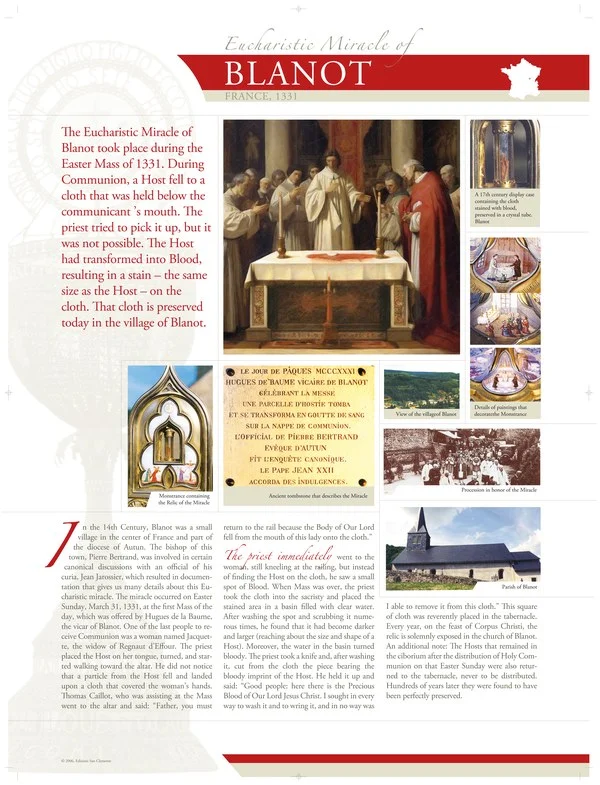
The Eucharistic Miracle of Blanot took place during the Easter Mass of 1331, During Communion, a Host fell to a cloth that was held below the communicant 's mouth, The priest tried to pick it up, but it was not possible, Tie Host had transformed into Blood, resulting in a stain — the same size as the Host — on the cloth, That cloth is preserved today in the village of Blanot, n the 14th Century, Blanot was a small village in the center of France and part of the diocese of Autun. Ile bishop of this town, Pierre Bertrand, was itwolved in certain canonical discussions with an offcial of his curia, Jean Jarossier, which resulted in documen- tation that gives us many details about this Eu- charistic miracle. The miracle occurred on Easter Sunday, March 31, 1331, at the first Mass of the day, which was offered by Hugues de la Baume, the vicar of Blanot.
One of the last people to re- ceive Communion was a woman named Jacquet- te, the widow of Regnaut d'Effour. The priest placed the Host on her tongue, turned, and star- ted walking toward the altar. He did not notice that a particle from the Host fell and landed upon a cloth that covered the woman's hands.
Thomas Caillot, who was assisting at the Mass went to the altar and said: "Father, you must Etoe L/"östöe GÉLÉBRANT LA MESSE UNE PARCELLE 1)'110STiF. TOMBA ETs SE TRANSFORMA ICN GOUTTE DE SANG SUR LA NAPPE DE COMMUNiON. L'OFFiCiAL DE l)iERRE BERTRAND EVIhQUE D 'AUTUN Firr 1]ENQUiCTE CANONiQUE.
ACCORDA DES iNDULGENCES. return to the rail because the Body of Our Lord fell from the mouth of this lady onto the cloth.' went to the wom , still kneeling at the r Ing, but instead of finding the Host on the cloth, he saw a small spot of Blood. When Mass was over, the priest took the cloth into the sacristy and placed the stained area in a basin filled with clear water.
After washing the spot and scrubbing it nume- rous times, he found that it had become darker and larger (reaching about the size and shape of a Host). Moreover, the water in the basin turned bloody. The priest took a knife and, after washing it, cut from the cloth the piece bearing the bloody imprint of the Host.
He held it up and said: "Good people: here there is the Precious Blood of Our Lord Jesus Christ. I sought in every way to wash it and to wring it, and in no way was Parish of Blanot Every year, on the feast of Corpus Christi, the relic is solemnly exposed in the church of Blanot. An additional note: The Hosts that remained in the ciborium after the distribution of Holy Com- munion on that Easter Sunday were also retur- ned to the tabernacle, never to be distributed.
Hundreds of years later they were found to have been perfectly preserved.
🔬 Scientific & Forensic Investigation
Rigorous histological, immunological and chromatographic analysis verified authentic human tissue with no chemical preservatives.
Relic Gallery & Historical Records
Fotografias em alta definição das sagradas relíquias, basílicas e documentos históricos catalogados por São Carlo Acutis. Clique para ampliar.

Monstrance containing the Relic of the Miracle

Ancient tombstone that describes the Miracle

Procession in honor of the Miracle I able to remove it from this cloth." This square of cloth was reverently placed in the tabernacle.

Historical artwork and preserved documentation of the Eucharistic Miracle of Blanot (1331)

Blanot

Details of paintings that decoratethe Monstrance

View of the villageof Blanot

Panoramic view of the Sanctuary and high altar honoring the Eucharistic Miracle of Blanot (1331)

A 17th century display case containing the cloth stained with blood, preserved in a crystal tube.

FRANCE, 1331
Original Exhibition Panels by Saint Carlo Acutis (300 DPI)
Inspecione a composição gráfica original em alta resolução (300 DPI, formato 60×80 cm), com o design e tipografia preservados exatamente como idealizados pelo autor.