Highlights
Listen
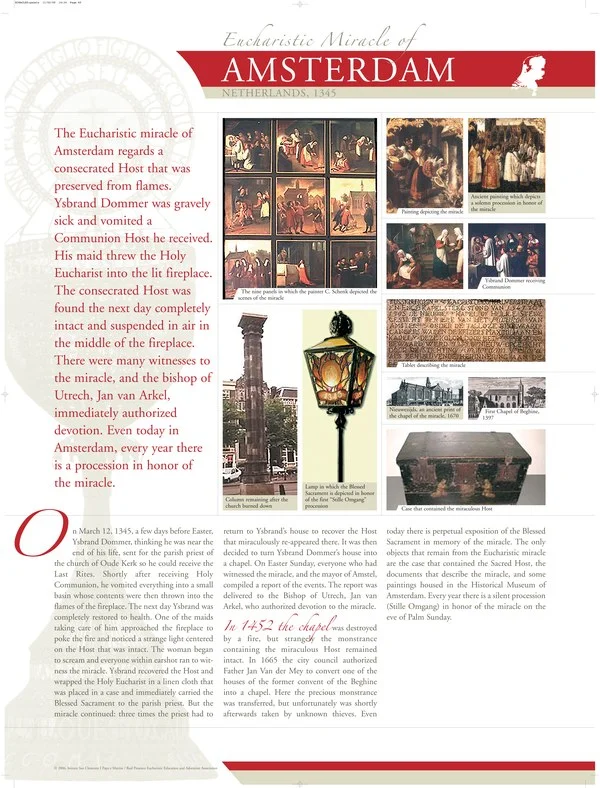
MIRACLES-panels 11/02/08 14:34 Page 60 The Eucharistic miracle of Amsterdam regards a consecrated Host that was preserved from flames, Ysbrand Dommer was gravely sick and vomited a Communion Host he received. His maid threw the Holy Eucharist into the lit fireplace, The consecrated Host was found the next day completely intact and suspended in air in the middle of the fireplace, There were many witnesses to the miracle, and the bishop of Utrech, Jan van Arkel, immediately authorized devotion, Even today in Amsterdam, every year there is a procession in honor of the miracle, n March 12, 1345, a few days before Easter, Ysbrand Dommer, thinking he was near the end of his life, sent for the parish priest of the church of Oude Kerk so he could receive the Last Rites. Shortly after receiving Holy Communion, he vomited everything into a small basin whose contents were then thrown into the flames of the fireplace.
The next day Ysbrand was completely restored to health. One of the maids taking care of him approached the fireplace to poke the fire and noticed a strange light centered on the Host that was intact. The woman began to scream and everyone within earshot ran to wit- ness the miracle.
Ysbrand recovered the Host and wrapped the Holy Eucharist in a linen cloth that was placed in a case and immediately carried the Blessed Sacrament to the parish priest. But the miracle continued: three times the priest had to NETHERLANDS, 1345 SE$'3 decided to turn Ysbrand Dommer's house into a chapel. On Easter Sunday, everyone who had witnessed the miracle, and the mayor of Amstel, compiled a report of the events.
The report was delivered to the Bishop of Utrech, Jan van Arkel, who authorized devotion to the miracle. as destroyed by a fire, but strange the monstrance containing the miraculous Host remained intact. In 1665 the city council authorized Father Jan Van der Mey to convert one of the houses of the former convent of the Beghine into a chapel.
Here the precious monstrance was transferred, but unfortunately was shortly afterwards taken by unknown thieves. Even Case that contained the miraculous Host today there is perpetual exposition of the Blessed Sacrament in memory of the miracle. The only objects that remain from the Eucharistic miracle are the case that contained the Sacred Host, the documents that describe the miracle, and some paintings housed in the Historical Museum of Amsterdam.
Every year there is a silent procession (Stille Omgang) in honor of the miracle on the eve of Palm Sunday. MIRACLES-panels 11/02/08 14:34 Page 61 NETHERLANDS, 1345 ;itfr monstrauce Atgoeye 'N RAUEN VAN L" rr.z••. ffsss: vat. bat F. uu• 2010 j 'tr. 11.10 ia d: Zizz rac 0' G»rtte u'
🔬 Scientific & Forensic Investigation
Rigorous histological, immunological and chromatographic analysis verified authentic human tissue with no chemical preservatives.
Relic Gallery & Historical Records
Fotografias em alta definição das sagradas relíquias, basílicas e documentos históricos catalogados por São Carlo Acutis. Clique para ampliar.

the chapel of the miracle, 1670

The nine panels in which the painter C. Schenk depicted the scenes of the miracle Column remaining after the church burned down return to Ysbrand's house to recover the Host that miraculously re-appeared there. It was then

Ancient painting which depicts a solemn procession in honor of the miracle Painting depicting the miracle

The sick man Ysbrant Hem receiving Holy Viaticum in his home on Kalverstraat (1345)

The miraculous Sacred Host floating unharmed above the burning coals in the fireplace

Lamp in which the Blessed Sacrament is depicted in honor of the first "Stille Omgang" procession

Tablet describing the miracle

First Chapel of Beghine, 1397

AékiJSr ECSTOFD<VAN'Ü3.4 •fSQSDb HF.flJc

Nieuwezijds, an ancient print of

The servant woman retrieving the miraculous Host unharmed from the flames with bare hands

Painting depicting the miracle

before the reliquary of the Nun of the Order miraculous Host (1484) of Beghine Chapel of the Blessed Sacrament

Faqade of the current church of Beghine, Amsterdam STIU.E OMGAKG DE NACHT VAN 18 OP 19 "OPD',r ALLEN EN ZUN"

The "Stille Omgang" procession held annually in memory of the miracle Archduke Maximilian of Austria portrayed in adoration

Historical artwork and preserved documentation of the Eucharistic Miracle of Amsterdam (1345)

Pamphlet of the "Stille Omgang" procession Interior of the church

Modern representation of the miracle

Sculpture of the ancient monstrance which contained the miraculous Host

Saw '*S. en iiJ yan 3:u. C.v.or.R •.e 9.21 GS id.:Ü2.v

Panoramic view of medieval Amsterdam with the Chapel of the Holy Site (Heilige Stede)

Interior of the ancient Heilige Stede sanctuary built on the site of the miracle house

Stained glass window commemorating the miraculous preservation of the Host in 1345

Historical silver medal commemorating the 500th anniversary of the Mirakel van Amsterdam

The Silent Walk ('Stille Omgang') nocturnal procession held annually through Amsterdam's canals

Pilgrims walking the sacred route in silent prayer through Kalverstraat

The chapel of the church was destroyed again in 1908

Gilded monstrance in the Begijnhof church preserving the Eucharistic memory of Amsterdam
Original Exhibition Panels by Saint Carlo Acutis (300 DPI)
Inspecione a composição gráfica original em alta resolução (300 DPI, formato 60×80 cm), com o design e tipografia preservados exatamente como idealizados pelo autor.